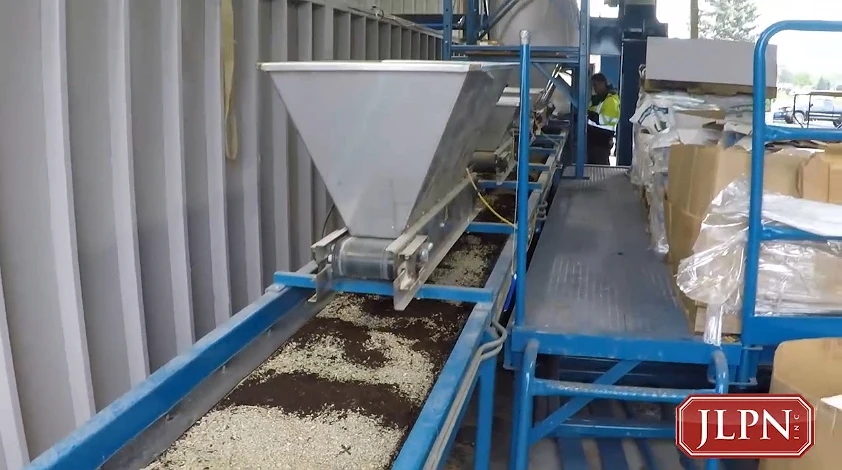
Increased production costs coupled with a dwindling labor pool were two big reasons that were affecting margins and profitability at JLPN. Instead of making a few insignificant tweaks to production processes, JLPN made a large investment and purchased an in-line potting soil/planting machine.
“It’s the single biggest addition we have made at JLPN in recent years. For years we were making soil five yards at a time with an old cement mixer. When we were small and naïve to profit margins, it worked fine. But once the cost of business started going up in all directions, we realized that our speed and output of potting soil was not only bottle-necking our production time, but bottle-necking the entire spring operations. This scenario also created massive stress load on my managers to keep up with production and chasing the ever germinating seed,” says JLPN President John Lewis.
Nicknamed “The Blue Beast,” this piece of automation has considerably increased efficiency, due to the speed in which the JLPN crew can complete jobs, but also because several individual processes were consolidated into one streamlined event.
“We used to make the soil, fill the flats, load them on a trailer, take them to the greenhouse, unload them to come back at a later date to plant,” Lewis explains. “When we came back, we would shuffle a table down the greenhouse, everyone would pick up the flat, plant the seeds, top dress, set back on the ground, and then a guy would come through and hand water. This times 80 greenhouses! It took forever, and the stress load was terrible.”
But thanks to The Blue Beast, things are much more efficient.
“Now one guy fills all the component bins, one guy puts flats into the flat filler, and a crew of about eight plant seeds. When the flat hits the end of the line, it’s top-dressed, watered, and takes a trailer ride to the greenhouse, where the crew offloads. We can produce 50 percent more a day, with the same number of people as we used to. Plus, the system works for producing rooted cuttings as well. We can now produce up to five times the volume in a day,” he adds.
With increased efficiencies came increased margins, which in the past had been shrinking.
“While it was a substantial investment, it took this type of equipment to make seedling and rooted cutting production profitable again,” Lewis says.
The crew’s stress level plummeted after implementing this piece of equipment.
“Another plus side was the amount of relief it provided my crew in getting the crop planted. Where spring planting used to require a high level of strategy to get the mission accomplished, they can now easily get all of the crops planted with little problem. It’s also upped our production capability and efficiency immensely and made the work for our crew far easier, in terms of lifting flats all day,” he adds.
The increased production volume and higher margins aren’t just good for JLPN, for the Lewis’ customers, as well.
“What we created for our customers was cost control through implementing efficiencies. There is no doubt that costs are going up fast, in all areas. There are only so many ways to control the costs while still creating a margin without pricing yourself out of the market. That’s what the Beast has created. We will have the ability to operate efficiently, keep prices under control, and still make a margin for many years to come because we’ve invested in labor saving equipment. The downstream effects are huge for our customers as well. They are able to pass on the savings for their customers,” Lewis says.
Another reason to outsource your overhead and let JLPN take care of your propagation needs.
To see a video of The Blue Beast in action, go here.
To learn more about JLPN products and services, contact John Lewis.
And hear more about John Lewis' take on automation in the industry from a previous interview here.
Latest from Nursery Management
- [SNEAK PEAK] Leading Women of Horticulture: Louise Schaefer and Susan Tantsits
- The Growth Industry Episode 10: State of the Horticulture Industry
- Tennessee Green Industry Field Day scheduled for June 11
- UTIA and UT Knoxville research teams will develop automated compost monitoring system
- Ken and Deena Altman receive American Floral Endowment Ambassador Award
- [SNEAK PEEK] Leading Women of Horticulture: Becky Thomas
- [SNEAK PEEK] Leading Women of Horticulture: Angela Burke
- [SNEAK PEEK] Leading Women of Horticulture: Alexa Patti