In May 2010, Florida Department of Agriculture and Consumer Services, Division of Plant Industry
(FDACS-DPI) staff were alerted to the possible presence of ash whitefly at Lake Buena Vista. A subsequent inspection of containerized pomegranate trees (Punica granatum) revealed a moderate infestation of the ash whitefly on several trees. In early September 2010, a DPI entomologist collected specimens from a pomegranate at a private residence in Panama City, Fla.
Some hosts:
Cercis occidentalis, western redbud; Lagerstroemia indica, crape myrtle; Liriodendron tulipifera, tulip tree; Magnolia stellata, star magnolia; Fraxinus excelsior, European ash; F. latifolia, Oregon ash; F. ornus, flowering ash; F. syriaca, Syrian ash; F. uhdei, Shamel ash; F. uhdei ‘Tomlinson’, Tomlinson ash; F. velutina ‘Modesto’, Modesto ash; F. velutina var. glabra, Arizona ash; F. velutina var. coriacea, velvet ash; Ligustrum spp., privets; Punica granatum, pomegranate; Rhamnus alaternus, Italian buckthorn; Chaenomeles speciosa, flowering quince; Malus floribunda, Japanese flowering crabapple; M. fusca, Oregon crabapple; Malus ‘Hopa’, Hopa crabapple; Malus ‘Red Jade’, red Jade crabapple; Malus x scheideckeri, Scheidecker crabapple.
The pest is established in California, but at low levels, and reported from Arizona, New Mexico, Nevada, South Carolina and Georgia. It was formerly established in parts of North Carolina, but is not currently of any economic concern.
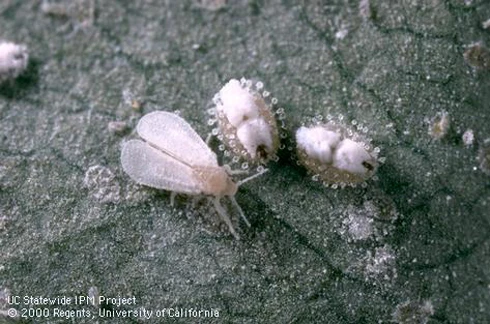
Pictured: Ash whitefly (photo courtesy of UC Statewide IPM Project)
Latest from Nursery Management
- [SNEAK PEAK] Leading Women of Horticulture: Louise Schaefer and Susan Tantsits
- The Growth Industry podcast Episode 10: State of the Horticulture Industry
- Tennessee Green Industry Field Day scheduled for June 11
- UTIA and UT Knoxville research teams will develop automated compost monitoring system
- Ken and Deena Altman receive American Floral Endowment Ambassador Award
- [SNEAK PEEK] Leading Women of Horticulture: Becky Thomas
- [WATCH] Taking root: The green industry’s guide to successful internships
- [SNEAK PEEK] Leading Women of Horticulture: Angela Burke