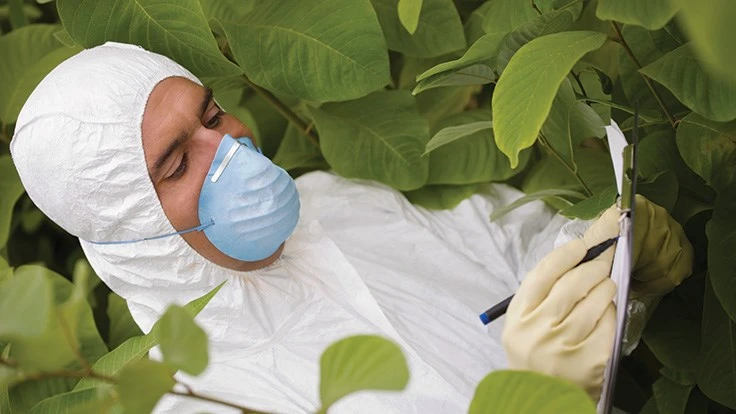
Each year, between 1,800 and 3,000 occupational incidents involving pesticide exposure are reported from the farms, forests, nurseries and greenhouses covered by the Worker Protection Standard. There is widespread underreporting.
The Environmental Protection Agency has revised the 1992 Agricultural Worker Protection Standard regulation to increase protection from pesticide exposure for the nation’s two million agricultural workers and their families. Drawing from 20-plus years of implementation and a thorough stakeholder review, EPA decided it was time for an update. The proposal reflects current research on best practices for mitigation of occupational pesticide exposure to agricultural workers and handlers. It aims to strengthen the protections provided to agricultural workers that handle pesticide products under the WPS by improving elements of the existing regulation, such as training, notification, communication materials, use of personal protective equipment, and decontamination supplies.
EPA's goal for the changes is to afford agricultural workers similar health protections that are already afforded to workers in other industries while taking into account the unique working environment of many agricultural jobs.
The regulation seeks to protect and reduce the risks of injury or illness resulting from agricultural workers’ (those who perform hand-labor tasks in pesticide-treated crops, such as harvesting, thinning, pruning) and pesticide handlers’ (those who mix, load and apply pesticides) use and contact with pesticides on farms, forests, nurseries and greenhouses. The regulation does not cover persons working with livestock. Major changes to the regulation:
•Annual mandatory training to inform farmworkers on the required protections. This increases the likelihood that protections will be followed. Currently, training is only once every 5 years.
•Expanded training includes instructions to reduce take-home exposure from pesticides on work clothing and other safety topics.
•First-time ever minimum age requirement: Children under 18 are prohibited from handling pesticides.
•Expanded mandatory posting of no-entry signs for the most hazardous pesticides. The signs prohibit entry into pesticide-treated fields until residues decline to a safe level.
•New no-entry application-exclusion zones up to 100 feet surrounding pesticide application equipment will protect workers and others from exposure to pesticide overspray.
•Requirement to provide more than one way for farmworkers and their representatives to gain access to pesticide application information and safety data sheets – centrally-posted, or by requesting records.
•Mandatory record-keeping to improve states’ ability to follow up on pesticide violations and enforce compliance. Records of application-specific pesticide information, as well as farmworker training, must be kept for two years.
•Anti-retaliation provisions are comparable to Department of Labor’s (DOL’s).
•Changes in personal protective equipment will be consistent with the DOL’s Occupational Safety & Health Administration standards for ensuring respirators are effective, including fit test, medical evaluation and training.
•Specific amounts of water to be used for routine washing, emergency eye flushing and other decontamination, including eye wash systems for handlers at pesticide mixing/loading sites.
•Continue the exemption for farm owners and their immediate family with an expanded definition of immediate family.
The majority of the rule revisions will be effective on January 2, 2017. This will give affected stakeholders and individual states time to adjust to the new requirements, as well as time for EPA and states to develop updated materials for training and other purposes.
EPA says its changes “provide significant improvements to worker training regarding the safe use of pesticides, including how to prevent and effectively treat pesticide exposure.” A big part of safety is the use of personal protective equipment, or PPE.
The EPA’s Labeling Requirements for Pesticides and Devices require that pesticide products sold for agricultural use include precautionary label statements addressing dermal protection. Any product that contains a pesticide – including baits, aerosols, fertilizers, seed, organic pesticides, even “natural” products – must be handled using the required PPE in the correct way. The required PPE could be chemical-resistant gloves or a respirator. It varies for different pesticide products and for different formulations of the same product. The required PPE may be different for tasks such as mixing, loading, application, repair, cleanup and/or early entry into a treated area.
PPE requirements can change at any time due to new research and/or regulatory requirements, so read the entire label every time you purchase a pesticide. The current PPE regulations under the current WPS are available here.
Photo: Thinkstock
Latest from Nursery Management
- [SNEAK PEAK] Leading Women of Horticulture: Louise Schaefer and Susan Tantsits
- The Growth Industry Episode 10: State of the Horticulture Industry
- Tennessee Green Industry Field Day scheduled for June 11
- UTIA and UT Knoxville research teams will develop automated compost monitoring system
- Ken and Deena Altman receive American Floral Endowment Ambassador Award
- [SNEAK PEEK] Leading Women of Horticulture: Becky Thomas
- [SNEAK PEEK] Leading Women of Horticulture: Angela Burke
- [SNEAK PEEK] Leading Women of Horticulture: Alexa Patti