For growers in regions with cold winters, maintaining crops through those long months of January and February is a difficult but necessary part of the growing process.
According to UMass Extension, part of University of Massachusetts – Amherst’s Center for Agriculture, Food and the Environment, there are several techniques growers can use to protect their crops. Which one will work best for you? It depends on the crop and how cold your winter will get.
Most containerized perennials and woody nursery stock held over winter need protection from cold. Unlike field grown plants, container-grown plants cannot take advantage of the temperature buffering effect of the soil. Roots are much less cold-hardy than the shoots. Since most roots of plants growing in containers tend to spiral around the inside wall of the container, the only insulation these roots have is the thin wall of plastic. Research in Oklahoma has shown that the temperature of the root ball in an unprotected container can approach that of the ambient air. These colder root zone temperatures increase the probability of cold injury to roots of plants otherwise considered hardy when grown in the field. Therefore, winter protection of container plants is essential to their survival.
In addition to root hardiness, factors such as soil moisture, temperature fluctuations, and root development in the container also affect plant survival.
Thermal blankets
If you need to maintain your plants at below freezing temperatures, thermal blankets are a good solution.
It's a simple technique growers use to keep plants at a constant temperature below freezing is placing a sheet of insulating material over containerized plants during the coldest months of winter. Commonly used thermal blanket materials include Microfoam (¼" flexible, polypropylene foam), The Winter Blanket (polyethylene foam, laminated with 3-mil UV resistant P/E) and Guilbond (1/4" closed cell polyethylene foam laminated to white UV treated polyethylene film). There are also fleece materials available that work. Containerized herbaceous perennials that are ready for storage can be placed pot to pot in an upright position on the ground in the production yard and simply covered with a material having insulating qualities. Tall plants can be leaned over just like laying shingles, exposing as much foliage as possible to light. Coverings are usually secured by tucking the edges underneath the containers or by weighing down the edges with heavy objects such as crushed stone or rocks. The thermal blanket sheets should be oriented in a north-south direction. With some thermal blankets, sheets of 4 mil white polyethylene plastic are placed over the blanket; other types do not need this extra layer of plastic. Follow the manufacturer's recommendation. At the end of the winter season, store thermal blankets in a dark area so they will last two or more years.
In locations where air temperatures are likely to fall to -10 degrees F, or where land is exposed to high winds, consider using a double foam layer or placing plants inside an unheated greenhouse under foam or in a minimally-heated greenhouse (see below). Thermal blanket systems are relatively inexpensive as compared to other methods of winter protection. They also trap and contain moisture sufficiently to eliminate the need for supplemental irrigation during the winter. However, problems under the blankets are difficult to detect because the blankets are opaque. Also, containers stored under thermal blanket systems tend to warm prematurely during winter thaws or near the end of the storage period. Warming may result in shoot growth that can be injured by the return of freezing temperatures. Therefore, venting may be advisable during unexpected periods of warm winter weather. Finally, thermal blankets are usually so tight in respect to air exchange that ventilation is practically non-existent. In areas where 3 to 4 months of cover are required, growers must be concerned with the development of molds and decay.
Unheated Quonset Polyhouses and Polyhuts
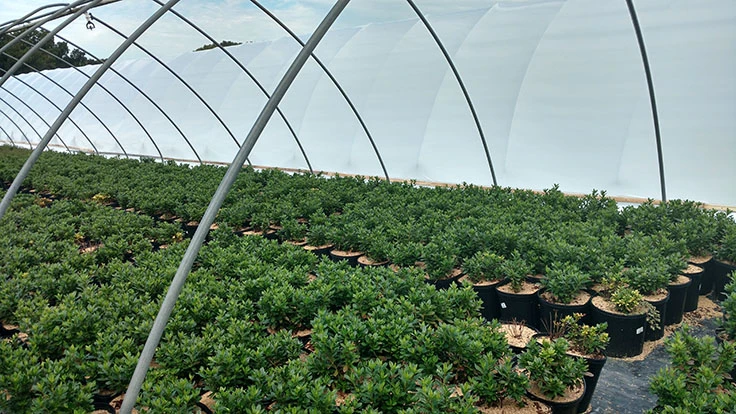
Another common way growers overwinter plants below freezing is by using unheated quonset polyhouses. These structures are usually constructed with wooden frames to which uniformly bent galvanized pipe are attached. The pipe provides the basic structure that supports one or two (air-inflated) layers of polyethylene that are secured to the wooden baseboards to which the bows are also secured. Under average conditions, temperatures within these structures do not reach levels that result in injury to plants that are stored inside. However, during extended periods of extreme cold (more than two consecutive nights when ambient temperatures go below 0º F), plant injury may occur.
Once temperatures consistently drop to 25-30°F, pots can be covered with a thermal blanket, protecting plants from extreme cold. This technique can create a microclimate in the immediate vicinity of the plants that is 8 to 10 º F warmer than air above the blanket inside of the structure. Currently, it is recommended that the thermal blanket be placed over the plants only for the duration of the extremely low temperatures so as to avoid excessive moisture buildup in the container environment. During periods of prolonged warm weather, monitor the temperature of the pots closely. If the pot temperature consistently stays above 40°F, then remove the thermal blanket. Placing a layer of bagged leaves around the outside of the overwintering house will add an extra amount of insulation to the root area. Some growers use furnaces in their polyhouses for those extremely cold periods.
The process of taking the cover off the structure in spring is critical if plant injury is to be avoided. Gradual removal of the cover in February and March is suggested. First doors and windows are opened, then small vents are cut into the ridge of the cover. Later the vents are enlarged, and finally the cover is removed in late March to April.
Plants, especially those with foliage on them, must be checked frequently for outbreaks of botrytis and sprayed with a fungicide as needed. Phlox subulata and Myosotis spp. are especially vulnerable to rotting. The best structures are those that are large enough to easily check and treat plants.
For more information, including how to overwinter plants in above freezing temperatures, please read the UMass Extension fact sheet here.
Latest from Nursery Management
- Jackson & Perkins expands into Canadian market
- Green & Growin’ 26 brings together North Carolina’s green industry for education, connection and growth
- Marion Ag Service announces return of Doug Grott as chief operating officer
- The Garden Conservancy hosting Open Days 2026
- Registration open for 2026 Perennial Plant Association National Symposium
- Artificial intelligence applications and challenges
- Fred C. Gloeckner Foundation Research Fund calls for 2026 research proposals
- Harrell’s expands horticulture team with addition of Chad Keel