PHOTOS: MARK DWYER
Editor's Note: This article originally appeared in the September 2025 print edition of Nursery Management under the headline “Zelkova serrata ‘Goshiki’.”
One of my favorite mail order nurseries (since closed) was ArborVillage in Holt, Missouri. This nursery had a tempting range of amazing and rare woody plants that I was slowly acquiring for a public garden as the budget allowed. One such item was a very small ‘Goshiki’ variegated Japanese zelkova (Zelkova serrata). I planted this little “stick with roots” (grafted) in part shade in 2001 and watched it grow for 20 years and become one of my favorite trees.
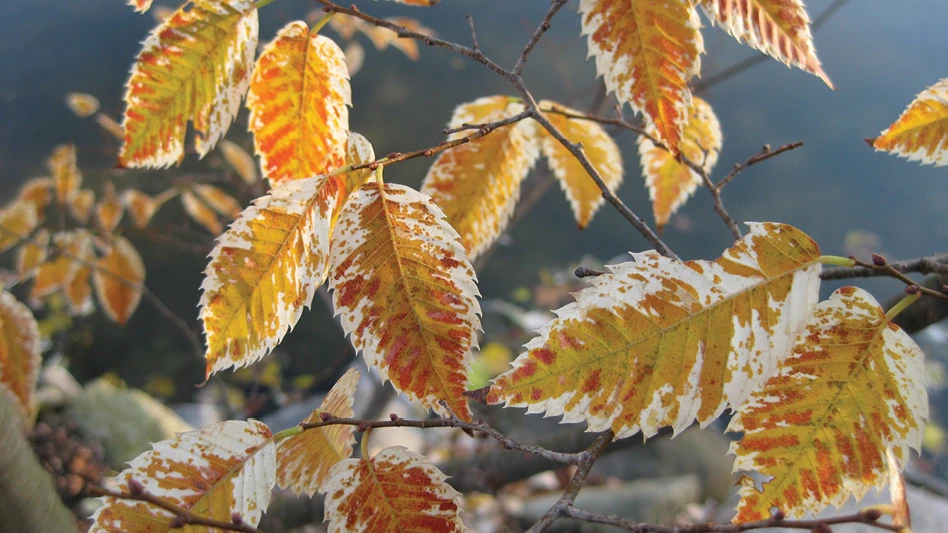
While I had used a few zelkovas in the past, it was the mesmerizing variegated foliage of ‘Goshiki’ that caught my attention. The white speckling throughout the leaf becomes a more solid margin along the serrated edges of an oval-shaped, elliptical leaf. Watching the progression of delicate leaves unfurling in spring, the summer variegation transitioning to more white and ultimately, the nice orange-pink fall color (with variegation intact) is a pure joy. I did observe another variegated variety called ‘Frost’ at the Chicago Botanic Garden which featured less speckling but a more pronounced white edge on the foliage.

Japanese zelkova, native to Korea, Japan, Taiwan and eastern China, is in the elm (Ulmaceae) family and is known for durability, longevity, size and a decent fall color. This species is highly resistant to Dutch elm disease and the elm leaf beetle. Zelkovas are also notably quite urban tolerant in terms of soils and air pollution. While the small green flowers and fruits (wingless drupes) don’t catch the eye, the form, foliage, fall color and bark are meritorious. Japanese zelkova features smooth, gray bark on younger specimens which later exfoliates with age to reveal an orange-brown, inner bark that is noteworthy.
The showy ‘Goshiki’ is thought to reach about 20 to 30 feet tall and wide with maturity. The one that I planted grew about 8 to 12 inches per year and was roughly 18 feet tall after 21 years. Good fertility, adequate moisture and well-drained soil (wide range of soil types are acceptable) are ideal for this species and selection. While locations in full sun or part sun are recommended, some shading does help with maintaining bold variegation and the fall color in the orange range still comes through nicely. The elegant, vase-shaped form of ‘Goshiki’ with upward-branching mimics the gracefulness of the larger, straight species. The stellar variegation makes ‘Goshiki’ glow in the landscape as a prominent focal point, worthy of consideration for any garden.

Explore the September 2025 Issue
Check out more from this issue and find your next story to read.