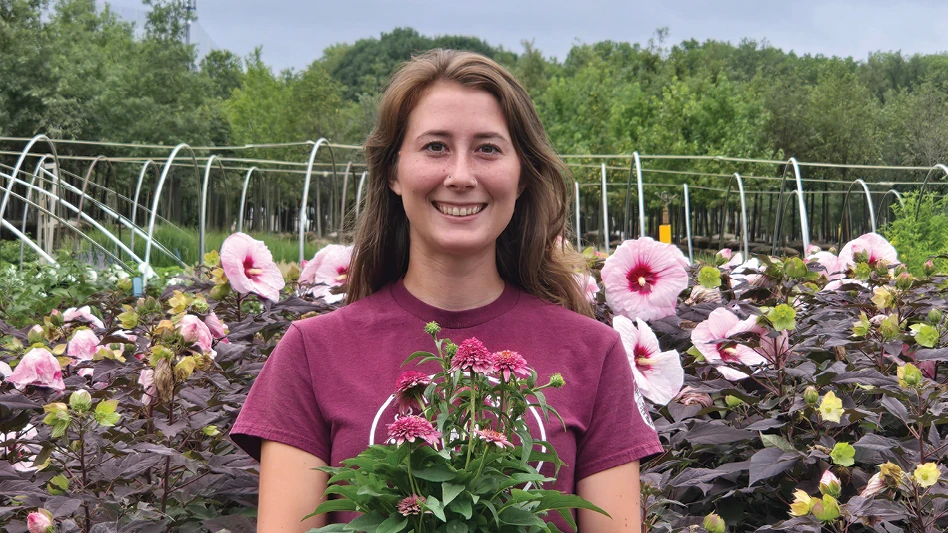
Photo: Acorn Farms
Editor's Note: This article originally appeared in the October 2025 print edition of Nursery Management under the headline “Q&A with Theresa Specht.”
Katie McDaniel: How did you get started in horticulture?
Theresa Specht: I’ve been interested in plants since I was a kid. I wasn’t raised on a farm or anything, but my parents always had a garden. You would usually find me outside, shoeless in the dirt, playing around and looking for bugs. My mom tells a great story about me as a kid where I would go out every day and weigh the little melons she had growing on the vines, just to see how much they’d grown in a day, and I would keep track of it.
As I got older, I started volunteering at a local greenhouse (Mulberry Creek Herb Farm), and I worked there all four years of high school. The owners, Mark and Karen Langan, basically treated me like one of their kids, and I was able to learn a lot through that experience with them. I still to this day go home and see them. I constantly thank them for nurturing that step into the horticulture world and for giving me the chance to dive into it.
I went to Ohio State to study horticulture, and throughout my years at Ohio State I did an internship at Winterthur Museum, Garden and Library in Delaware. I also worked a summer at Michigan State University; their radiology department has a greenhouse and gardens. I actually fell into this job because my friend got her internship at Michigan State and didn’t want to go alone, so I was like ‘Sure, I’ll go with you!’ I sort of ran into the gardens and the lady was like ‘Yeah, I need a summer worker.’ Then hired me on the spot.
Then I worked at Oakland Nursery in Columbus, Ohio, during my last two years of my undergrad. When I graduated in May 2020, I asked Mark Reiner (owner of Oakland Nursery) if I could be transferred over to the wholesale side of things, and that’s how I ended up at Acorn Farms in Galena, Ohio.
KM: What do you do as perennial grower at Acorn Farms?
TS: For the day to day, you have to roll with the punches. Depending on the day, it could be anything from going out walking and putting together work orders for pruning, spacing and moving for my crews to then planning during potting season and as liners come in, checking that everything is looking good as it comes in, as well as putting together a plan for what order we’re going to pot things, where they’re going to get set down out at the nursery and just trying to do the planning on the front side of things.
Then I also spend some time inside, on the computer. I make sure our invoices match up with the packing slips and get those turned in. I receive our liners and check them in to our inventory system and communicate with my liner suppliers. I also scout for insects or disease and take that information to our IPM specialist and go over the plans of action to solve those things.
For long term, I put together the production plan for our Galena farm perennials — putting together the orders for the liners and making sure our crop rotations are set up for the year, as well as for our Zanesville farm perennials, making sure they grow the big numbers like the Karl Foersters, the hosta Patriots — that kind of stuff. I have to make sure their production lines up with ours to be able to sell it, so I go out to our Zanesville farm once a week to make sure everything is going smoothly and put together work orders for them as well.
KM: What part of the job do you love the most?
TS: I love being out with the plants — my walks to put together the work orders, doing the prune samples, being able to be out there with the plants checking on things, getting my hands dirty; that’s my favorite part of it all.
KM: What types of plants do you grow?

TS: In my department, we grow 200 different genus and over 1,000 different line items. We grow a very wide selection of perennials, but we also have that bread-and-butter stuff, too. So, we tend to be a good one stop shop in terms of our perennial production. Our farm also encompasses shrub production; we sell B&B trees that we dig from our other farm. We also have an annual department.
KM: What are some of the challenges you face growing perennials?
TS: Some of the main challenges I’ve been facing have to do with how I want production to run — like grouping things together with their water needs, but also for efficiency.
We got a new potting machine in 2022 and that changed how quickly we can pot things. That was the start of the change of our production cycle because we needed the space to set [plants] down faster. When the machine is utilized to its full extent, it can go almost three times as fast as our old potting line and machine. So, to be able to utilize the machine to its fullest extent, as well as grow our perennial production, I had to analyze the amount of work that goes into the prepping to be able to put all of our PW pot plants together, so we’re not having to switch out containers as we’re potting, as well as trying to sort high-water plants and low-water plants, sun versus shade and trying to bulk plant instead of having a crew bouncing half way across the farm to be able to set down one group here, one group there. All the high-water plants get set down together and we pot them together.
This is something that I still struggle with in terms of playing the Tetris game of getting everything to fit but also not sacrificing the quality of our plants. It’s going to be a constant back and forth on trying to figure out what works best for our workflow and for the plants.
KM: Is there anything the nursery does differently?
TS: The amount of detail that goes on our signage is unique — to be able to make it not only useful for us on the production side but also for sales and for our pull crews in our shipping department. It’s a universal sign that helps everyone who would possibly be touching the plant or looking for the plant, navigate our nursery.
It comes back to the fact that we have a sales yard here; it’s not only our people touching our product. Daily, we have landscapers come in to get product, and stuff is constantly moving here. Not only does each plant get tagged, but we also try to do a good job labeling each of our crops.
We have white signs that get stickers with our plant ID code, plant name and a scan code I put the company that we received the liners from on it and the quantity per crop. Each crop gets two [signs] that stay with them and each individual pot gets a pot tag. We add another sign to mark crops as saleable material and as an indicator for our sales team.
KM: How do you unwind after a busy day?
TS: My husband and I have three cats at home, so sometimes I’ll snuggle up with them. We have a few acres of woods on our land, so sometimes we’ll go out and get into a project in the woods. I also do a lot of crafting like sewing or making t-shirts with my Cricut. It just depends on what kind of busy day it was.
Explore the October 2025 Issue
Check out more from this issue and find your next story to read.