Photos: Mark Leichty

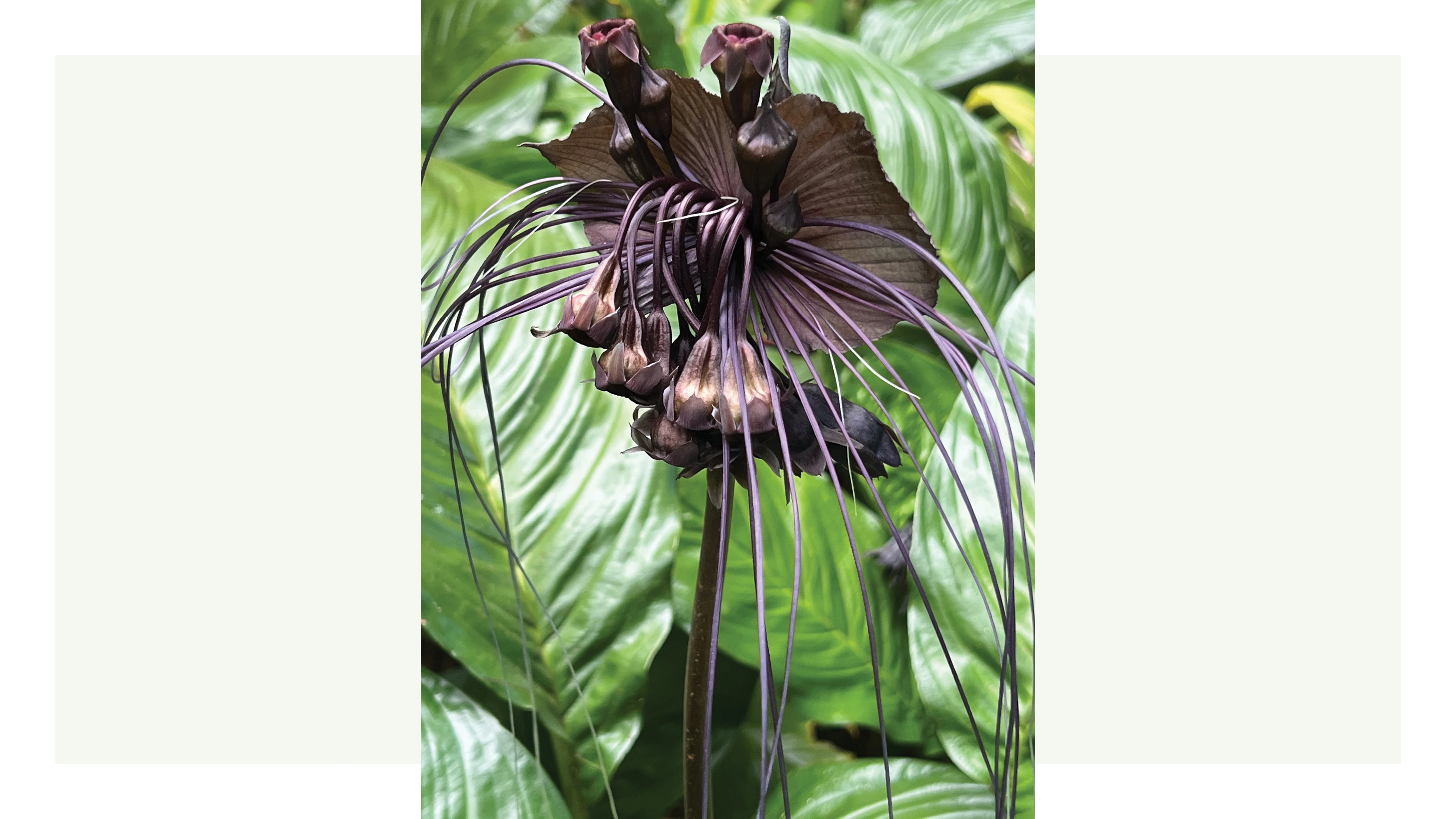
I am currently recovering from a major reconstruction surgery of my right foot. I’m four weeks in and will be non-weight bearing for another two weeks. I am trying not to be bored sitting around with my leg elevated and in a cast. It's been a good time to organize plant photos I’ve taken during the past few years. This past February, Michelle and I visited the Hawaiian Tropical Bioreserve and Garden near Hilo. It is a must-see garden if you go over to The Big Island in the future. The 40-acre garden contains over 2,000 species of tropical plants from all over the world. This column is called ‘Flora Exotica,’ and I can think of few flowers that look more “exotic” than Tacca chantrieri, or black bat plant.
T. chantrieri is a member of the yam family, Dioscoreaceae. It is native to southeast Asia. There are 16 species of Tacca found in tropical regions around the world. T. chantrieri is the most commonly grown species in ornamental horticulture. Since it’s a tropical plant, it's limited to being used as a houseplant in most of North America, though it can be grown outdoors in Florida and parts of the deep south, and in parts of southern California.
I have been growing T. chantrieri for about 25 years in commercial horticulture. Its black flowers bear a striking resemblance to a bat, with petals that are shaped like a bat’s wing. The long, drooping bracteoles look like whiskers protruding from a bat’s face. Several North American suppliers sell liners of T. chantrieri, and it is relatively easy to grow in a greenhouse with appropriate heat and humidity. A number of online plant retailers list Tacca for sale. We have been growing it at Little Prince for a few years. It blooms from late summer through fall, as daylength gets shorter. It grows naturally in low-light situations and thus needs shade in the greenhouse.
I’m ready to shed my cast, and I hope when you see me at MANTS, I will be walking without my knee scooter! For now, I’m content to sit and dream and plan a trip to Maui this coming February.

Explore the November 2025 Issue
Check out more from this issue and find your next story to read.
Latest from Nursery Management
- [SNEAK PEEK] Leading Women of Horticulture: Angela Burke
- Get to know Hailey Clark
- Get to know Brian Kemble
- Proven Winners partners with Pure Line Seeds to offer vegetable plants
- Award winners announced for 2026 PHS Philadelphia Flower Show
- Kansas City botanical garden Powell Gardens acquires IGC Colonial Gardens
- [SNEAK PEEK] Leading Women of Horticulture: Delilah Onofrey and Krystal Snyder
- [SNEAK PEEK] Leading Women of Horticulture: Alexa Patti