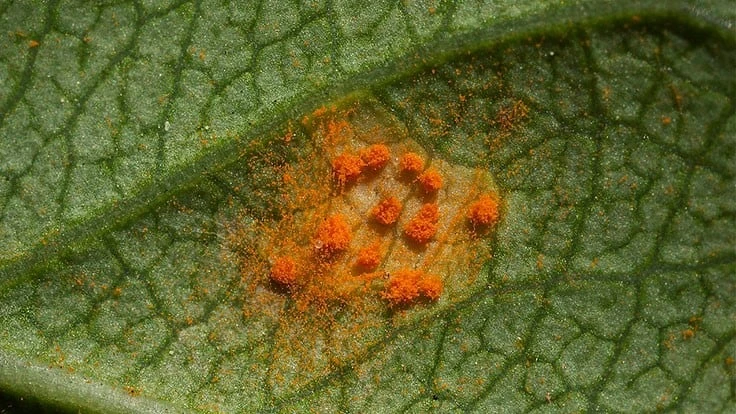
Rust diseases are common fungal infections that affect a wide range of horticultural crops, including aster, rose and shade trees in the nursery industry. Rusts have the potential to negatively impact nursery production because these pathogens often cannot be detected on infected, but symptomless propagation material entering the U.S. or moving state-to-state. Rust fungi are obligate parasites, dependent upon a live host for growth and development, and seldom kill plants. However, rust infection reduces plant health and vigor, flower production, and aesthetic value.
Each type of rust has its own distinctive symptoms and its own specific plant hosts. The disease often first appears as chlorosis on the upper surfaces of leaves. All rust fungi produce powdery masses of spores in pustules, typically on leaf undersides that are yellow, orange, purple, black or brown. Some rust fungi produce pustules on upper leaf surfaces as well. Spores are easily spread on air or with splashing water. Lesions may coalesce resulting in large areas of necrosis; leaf distortion and defoliation often follow.
Let’s focus on rose rust, caused by Phragimidium mucronatum.
Source: UMass Extension Plant Diagnostic Lab, University of Massachusetts