Editor's Note: This article originally appeared in the July 2025 print edition of Nursery Management under the headline “Long-term control.”
The redheaded flea beetle, Systena frontalis, is an insect pest of container grown nursery production systems in the Midwest, Northeast and Southeast regions of the United States. Redheaded flea beetle adults feed on the leaves of a wide range of ornamental plants grown in nursery production systems including, but not limited to: Cornus spp., Hydrangea spp., Itea spp. and Weigela spp. Redheaded flea beetle adults cause damage when feeding on the leaves of ornamental plants, leading to a reduction in aesthetic quality and salability, and an economic loss. For example, redheaded flea beetle adult feeding damage caused losses of $483,871, or 11%, of overall sale of plant material in 2020 at Loma Vista Nursery in Ottawa, Kansas.
Background on redheaded flea beetles
Redheaded flea beetle adults are five millimeters (one-fifth of an inch) long, shiny black, with a red head (Figure 1). They have enlarged hind femora that allow them to jump like a flea, hence the common name. Adults feed on the upper and lower leaf surfaces, resulting in necrotic leaf spotting and/or holes in leaves (Figure 2). The extent of feeding damage varies depending on the plant species fed upon. Redheaded flea beetle adults are difficult to manage with foliar applied insecticides because of their jumping behavior and tendency to fall onto the growing medium surface when disturbed, thus allowing them to escape exposure from insecticide sprays.

Foliar applications of insecticides are intended to protect leaves from feeding damage as opposed to directly killing redheaded flea beetle adults. However, foliar applications of insecticides do not provide adequate protection of leaves from redheaded flea beetle adult feeding damage during the growing season. In addition, insecticide spray applications need to be conducted on a weekly basis, which is labor intensive and not cost efficient for large nursery operations.
Systemic insecticides applied to the growing medium are absorbed by plant roots and distributed through the vascular system (i.e. xylem and phloem) into above-ground plant parts (e.g. leaves) where insects feed. Insects are killed when they ingest a lethal concentration of the systemic insecticide active ingredient during feeding. One of the primary benefits of systemic insecticides is that plants are protected for extended periods of time (e.g. eight to 10 weeks depending on the plant and systemic insecticide used) from feeding by insect pests, which can reduce foliar insecticide spray applications. Systemic insecticides are mainly used to protect plants from phloem and/or xylem-feeding insect pests such as aphids, whiteflies and leafhoppers. Our previous studies show that systemic insecticides can also protect plants from redheaded flea beetle adult feeding. However, there is no information on the long-term residual activity of systemic insecticides in protecting plants from feeding by redheaded flea beetle adults. Therefore, the objective of the study was to determine the residual activity of the systemic insecticides dinotefuran, thiamethoxam and acephate in the leaves of Itea virginica ‘Little Henry’ container-grown plants 310, 329 and 404 days after application against redheaded flea beetle adults.
Experiment materials and methods
The following study involved three experiments conducted under greenhouse conditions at Kansas State University, Manhattan, Kansas in 2024.
Experiment 1
I. virginica ‘Little Henry’ plants were initially obtained from Loma Vista Nursery in Ottawa, Kansas, on July 11, 2023. The plants were grown from cuttings using existing stock plants. The cuttings were transplanted on May 10, 2023, into 4.5 liter (1.0 gallon) containers with a growing medium consisting of 90% pine bark and 10% sand. The plants were fertilized with 18-2-7 (N:P:K) Nursery Polyon Controlled-Release Fertilizer with each 4.5 liter container receiving 15 grams (0.5 ounces) of fertilizer.
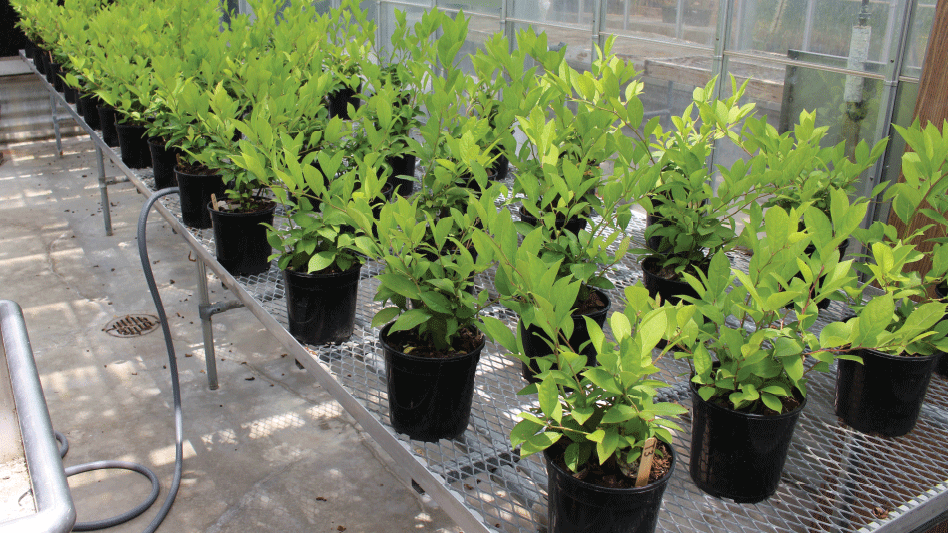
There were three systemic insecticide treatments including: dinotefuran (Safari), thiamethoxam (Flagship) and acephate (Acephate). On August 22, 2023, the treatments were prepared in 946 milliliter plastic spray bottles and 300 milliliters (10.1 fluid ounces) of each treatment solution was applied as a drench to the growing medium of each container using a 600 milliliter (20.1 fluid ounce) glass beaker. Plants were grown in a greenhouse at 22 to 50o C (72 to 122o F), 0 to 100% relative humidity and under natural light (Figure 3).
The experiment was set up as a completely randomized repeated measures design using glass Petri dishes (100 x 15 millimeters). There were four treatments, including a water control, and 10 replications per treatment. The treatments and application rates were as follows:
- Dinotefuran (Safari) at 18 ounces/100 gallons (1.27 grams/946 milliliters)
- Thiamethoxam (Flagship) at 7 ounces/100 gallons (0.49 grams/946 milliliters)
- Acephate (Acephate) at 12 ounces/100 gallons (0.85 grams/946 milliliters)
- Water control
A total of 90 redheaded flea beetle adults were collected on June 26, 2024, from container grown Hydrangea paniculata ‘Little Lime’ plants at Loma Vista Nursery. Adults were transported to the Horticultural Entomology and Plant Protection laboratory in the Department of Entomology at Kansas State University, aspirated into 33 milliliter (1.1 ounce) plastic vials, and starved for 24 hours.
On June 28, 2024, 310 days after the initial systemic insecticide application, 10 leaves were randomly collected from the treated plants in the greenhouse and placed into 3.8 liter (1.0 gallon) plastic storage bags associated with the appropriate treatment. The plastic storage bags were transported to the laboratory. One leaf and one redheaded flea beetle adult were randomly selected from the individuals collected and transferred into each Petri dish based on the appropriate treatment. The Petri dishes were covered with a lid and maintained in the laboratory at 20 to 21o C (68 to 70° F), 46 to 69% relative humidity and under constant light for 72 hours. The number of live or dead redheaded flea beetle adults was recorded 24, 48 and 72 hours after exposure to the I. virginica ‘Little Henry’ leaves to determine the effect of the treatments on the redheaded flea beetle adults. Percent redheaded flea beetle adult mortality was calculated by dividing the number of dead redheaded flea beetle adults per treatment by the total number of redheaded flea beetle adults in each treatment and then multiplying by 100. Data was analyzed using PROC GLIMMIX (α=0.05).
Experiment 2
The 126 redheaded flea beetle adults used in this experiment were collected on July 15, 2024 from container-grown H. paniculata ‘Bobo’ plants at Loma Vista Nursery. Adults collected were starved for 24 hours. The treatments were the same as in the first experiment. The experiment was set up as a completely randomized repeated measures design using glass Petri dishes (100 x 15 millimeters). On July 17, 2024, 329 days after the initial systemic insecticide application, 10 leaves were randomly collected from the treated plants, and placed into 3.8 liter plastic storage bags associated with the appropriate treatment. The procedures for experiment two were similar to the first experiment described above. However, the data associated with experiment two was not analyzed.
Experiment 3
Another 102 redheaded flea beetle adults to be used in the experiment were collected on September 10, 2024, from container grown I. virginica ‘Little Henry’ plants at Loma Vista Nursery. Adults collected were starved for 24 hours. The treatments were the same as the first two experiments. The experiment was set up as a completely randomized repeated measures design using glass Petri dishes (100 x 15 millimeters). On September 11, 2024, 404 days after the initial systemic insecticide application, 10 leaves were randomly collected from the treated plants and placed into 3.8 liter plastic storage bags associated with the appropriate treatment. The procedures for experiment three were similar to experiments one and two described above. However, the data associated with experiment three was not analyzed.
Results and discussion
Experiment 1
There was no significant treatment effect (P>0.05) on redheaded flea beetle adult mortality after 72 hours. Mortality was 50% (n=10) in the water control after 72 hours of exposure. Redheaded flea beetle adult mortality was 50% (n=10) in the thiamethoxam (Flagship) at 7 ounces/100 gallons (0.49 grams/946 milliliters) and acephate (Acephate) at 12 ounces/100 gallons (0.85 grams/946 milliliters) treatments after 72 hours, and 60% (n=10) in the dinotefuran (Safari) at 18 ounces/100 gallons (1.27 grams/946 milliliters) treatment after 72 hours.
Observations indicated there was feeding on leaves from plants treated with the systemic insecticide applications, which was similar to leaves fed upon in the water control. More leaf area was fed upon (approximately 60 mm2) in our previous experiments prior to redheaded flea beetle adult mortality after 72 hours across the treatments. In our previous experiments, mortality was as high as 90% from exposure and the leaf area fed upon was 1.1 to 13.8 millimeters2 after 72 hours associated with same systemic insecticide treatments and application rates and 15 days after the systemic insecticide applications.
For experiment one, no conclusion can be inferred regarding the residual activity of the systemic insecticides in protecting I. virginica ‘Little Henry’ container-grown plants from redheaded flea beetle adult damage 310 days after application due to high mortality (≥50%) of redheaded flea beetle adults collected from the field.
Experiment 2
Redheaded flea beetle adult mortality was 0% (n=10) in the dinotefuran (Safari) at 18 fluid ounces/100 gallons (1.27 grams/946 milliliters) and water control treatments, and was 10% in the acephate (Acephate) at 12 ounces/100 gallons (0.85 grams/946 milliliters) treatment after 72 hours. Therefore, there was no residual activity associated with dinotefuran and acephate. Redheaded flea beetle adult mortality was 80% (n=10) in the thiamethoxam (Flagship) at 7 ounces/100 gallons (0.49 grams/946 milliliters) treatment after 72 hours. We do not know if the redheaded flea beetle adult mortality was natural or related to the thiamethoxam treatment because redheaded flea beetle adults did feed on a few leaves. Thiamethoxam is converted into the metabolite clothianidin in insects and plants, and clothianidin concentrations in leaves following soil applications of thiamethoxam can be twice as high as thiamethoxam concentrations. It is possible that redheaded flea beetle adults that emerged from the containers early in the growing season ingested a lethal or sublethal concentration of clothianidin when feeding on the few leaves, which resulted in death.
In our observations, the leaf feeding on plants treated with the systemic insecticide applications was similar to the water control (as much as 56 millimeter2 of leaf area fed upon). More leaf area was fed upon (approximately 60 millimeter2) in our previous experiments before redheaded flea beetle adult mortality after 72 hours across the treatments. In prior experiments, mortality was 90% after exposure and the leaf area fed upon was 1.1 to 13.8 millimeter2 after 72 hours for the same systemic insecticide applications.
The conclusion from experiment two is that there was no residual activity 329 days after application associated with the dinotefuran and acephate treatments. However, we do not know what factors contributed to redheaded flea beetle adult mortality in the thiamethoxam treatment.
Experiment 3
Redheaded flea beetle adult mortality was 20% (n=10) in the dinotefuran (Safari) at 18 ounces/100 gallons (1.27 grams/946 milliliters), acephate (Acephate) at 12 ounces/100 gallons (0.85 grams/946 milliliters), and water control treatments after 72 hours. Hence, there was no residual activity affiliated with dinotefuran and acephate. Redheaded flea beetle adult mortality was 50% (n=10) in the thiamethoxam (Flagship) at 7 ounces/100 gallons (0.49 grams/946 milliliters) treatment after 72 hours. It is unclear if redheaded flea beetle adult mortality was natural or associated with the thiamethoxam treatment. Thiamethoxam is converted into the metabolite clothianidin in insects and plants and clothianidin concentrations in leaves following soil applications of thiamethoxam can be twice as high as thiamethoxam concentrations. In addition, the half life of clothianidin in the soil ranges from 148 to 1,155 days (0.4 to 3.1 years). Therefore, redheaded flea beetle adults may have ingested a lethal or sublethal concentration of clothianidin when feeding on the leaves resulting in death.
Observations indicated there was leaf feeding from plants treated with the systemic insecticide applications, which was similar to leaf feeding in the water control. The leaf area fed upon by redheaded flea beetle adults was approximately 60 mm2 before mortality after 72 hours across the treatments. Furthermore, in our previous experiments, redheaded flea beetle adult mortality was 90% after 72 hours and the leaf area fed upon was 1.1 to 13.8 mm2 for the same systemic insecticide treatments and application rates and 15 days after the systemic insecticide applications.
In conclusion, for experiment three, there was no residual activity 404 days after application associated with the dinotefuran or acephate treatments. However, the factors that contributed to redheaded flea beetle adult mortality in the thiamethoxam treatment are still not known.

Explore the July 2025 Issue
Check out more from this issue and find your next story to read.