Photo: Patrick Alan Coleman
Editor's Note: This article originally appeared in the December 2025 print edition of Nursery Management under the headline “Steamy sustainability.”
The slogan “Reduce, reuse, recycle” was born out of the ecological movements of the 1970s, as activists and conservationists sought to clean up an increasingly polluted United States. More than 50 years later, recycling and reuse have become standard practices for many industries, including horticulture, which has worked hard to tackle the plastic waste inherent in the growing process.
But while plastic and recycling have long been associated, there is another byproduct of greenhouse and nursery production that is re-entering the cycle: used growing media. Used media, particularly substrates made of organic material, are a fact of life in nearly all horticultural operations, according to Jeb Fields, Ph.D., a substrate scientist and assistant professor of nursery crops at the University of Florida.
“With nursery and floriculture, we’re hoping we’ve sold all the substrates. In a perfect world, we sell every bit of substrate. We know that doesn’t happen,” he says. “If you’re reusing substrate, that plant didn’t get sold. There was something going on with that plant.”
Inevitably, due to factors from soft demand to crop problems, a percentage of the plants grown will need to be discarded. It’s not uncommon for dump piles of unsold or unsalable product to creep ever higher in some corner of the growing operation.
In the past, it would eventually need to enter the waste stream, a possibly problematic issue if the material had been treated with pesticides or other horticultural chemicals. But during the past decade, the shift toward recycling has become more pressing.
“It’s being led by the need, the immediate need for peat,” Fields says. “I first started hearing a lot more chatter about reuse and recycling in the COVID years, when the supply chains broke down. There was a poor peat harvest, and it was tough for us growers to get peat. That’s when people started talking about reuse on a sizable scale.”
Since then, some of those companies have moved from talking about reuse to implementing substrate recycling. One of the companies now recycling a portion of its growing media is Miami-based houseplant and tropical grower Costa Farms.
There was one major factor that inspired Costa to begin its program. “Like anybody else, (we did it) for profitability,” explains Cesar Martinez, Costa’s senior director of environmental health and safety. “When you look at the cost of our coir and our coconut fiber, five years ago, you might be paying $25 a yard. Currently, with the political climate that we’re in, it’s upwards of $90 to $100 a yard, and that’s including being tariffed and everything else.”
The increasing cost of the coir was enough that Costa began to consider its own dump piles as a source of substrate additive to cut down on the cost of coir. Martinez and his team visited a friendly competitor that was already recycling growing media to explore their options. That visit prompted Costa to invest in a steaming system that would allow the company to steam-treat recycled substrate to neutralize pathogens or weeds.
Fields notes that plant health should be the primary consideration for any growers considering a recycling practice.
“When anyone is talking about reusing material, we talk about disease spread and contamination and sanitation. It is incredibly important,” he says. “Disease is a huge cause of financial loss and economic loss in our industry. Proper sanitation is the way to clear that up.”
Martinez says that Costa’s program was trialed extensively prior to implementation, including testing treated recycled material to ensure that it would not burden plants with additional disease, weed or pest pressures.

By the winter of 2024, during the heaviest potting season, the company had done enough testing to allow the recycling system to go into full operation. It has now been fully integrated into the substrate mixing, potting and planting process.
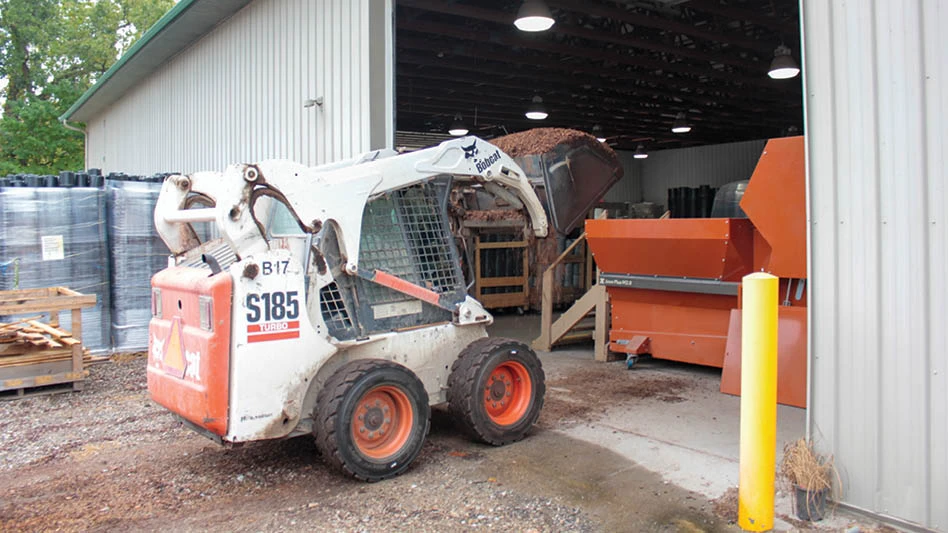
In Costa’s recycling system, unsold plants and their substrate (general wood fiber and coir) are collected into “dump trailers,” and all inorganic materials, like gloves, pots or other plastics, are removed. The dumped material is allowed to naturally break down while waiting to be transported by a third party, which grinds the root ball, plant material, coir and wood fiber to Costa’s specifications before screening it to catch any outsized pieces or missed inorganics. The processed material is then returned to Costa’s South Florida farm, where it was originally collected.
Once the material returns, it is heated via steam to 100 to 150 °F. This steam treatment represents the bulk of the investment in the project. The machine producing the steam is essentially a high-powered boiler that can produce enough heat to sanitize large bulks of processed material.
However, there was one hurdle in creating the system. While the boiler can produce the steam, it did not have an area for the material to be held while being sanitized. Costa had to custom build a container that could hold both the processed material and steam. To do so, the company retrofitted two semi-trailers that can each hold 10 to 12 yards of processed material. Steam from the boiler is pumped into these trailers for 30 minutes. Once sterilized, the trailers can be towed to the substrate mixing facility, where the material is incorporated into the standard mix as an amendment.
“Right now, we’re roughly doing about a 5 to 10% reincorporation rate,” Martinez explains. “And if you look at the savings on that, just in the 5 to 10% rate, it’s seven figures annually.”
That means the initial investment should pay for itself quickly. And that’s on top of the ecological benefits of keeping material out of landfills and reducing the fossil fuel burdens of coir imports.
The growing media recycling program did not require an increase in labor or a disruption of any existing processes for Costa, says Environmental Manager Maria Giudici.
“When you’re producing these dumps, it was already being segregated to make sure that it wasn’t going to the landfill. The system was in place,” she says. “The reincorporation really did not change either because it is getting sterilized at our central location. This is where the main potting mixes are generated. It didn’t change much of anything.”
Fields, who is not associated with Costa, is happy to see large growers taking on substrate recycling. He believes there is plenty of potential in the technology and hopes other growers will pursue it as well. But he does note that it’s important to have guidance.
“You need to have someone that knows what they’re doing, and it’s going to need specific equipment,” he says. “It’s pretty easy to steam sterilize something. You turn it on, you crank the temperature up and you just cook it. But to adjust the proper biological activity of the media, it’s going to take some finesse and knowledge and experience. My advice would be start small and work with researchers who are interested in this. And I think there’s plenty of people out there that would love to work with growers on solving these problems.”
Explore the December 2025 Issue
Check out more from this issue and find your next story to read.