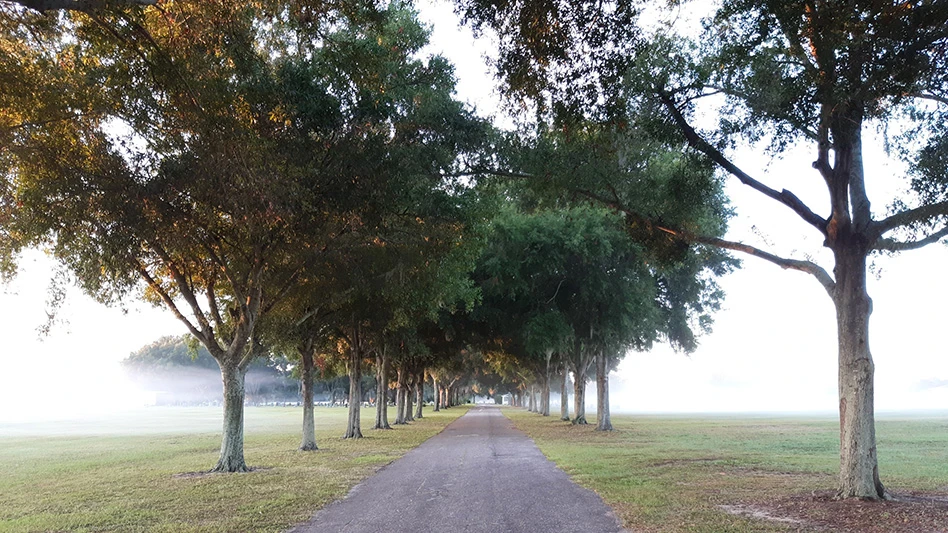
The leaves of swamp white oak are dark green on top and silvery white underneath, hence the species name. And when a breeze blows across the tree, the silvery underside contrasts with the dark green upper leaf surface, creating a shimmering effect.
Swamp white oak is a lowland tree and is native throughout most of the northeastern United States and as far west as Iowa and south to Arkansas. While it grows best in rich, deep, wet to even poorly drained soils, it also does well on dryer, compacted sites. Trees that can tolerate wet sites can often do well on compacted sites since their roots have developed to grow in low oxygen soils.
Swamp white oak starts out with a pyramidal shape but as it grows it becomes more rounded and spreading. There are very few pests of swamp white oak and it is a relatively easy tree to transplant.
Why grow Quercus bicolor?- Adaptable to several types of soil conditions.
- Native and hardy throughout a large area of North America.
- The bicolored leaves provide a light show of sorts when the breeze blows through the tree.
- No serious pest or disease problems.
Sources: Nebraska Forest Service, Ohio State University

Explore the January 2016 Issue
Check out more from this issue and find your next story to read.
Latest from Nursery Management
- Jackson & Perkins expands into Canadian market
- Green & Growin’ 26 brings together North Carolina’s green industry for education, connection and growth
- Marion Ag Service announces return of Doug Grott as chief operating officer
- The Garden Conservancy hosting Open Days 2026
- Registration open for 2026 Perennial Plant Association National Symposium
- Artificial intelligence applications and challenges
- Fred C. Gloeckner Foundation Research Fund calls for 2026 research proposals
- Harrell’s expands horticulture team with addition of Chad Keel