Photos: Mark Dwyer
I developed a fern and moss garden at a local botanic garden many years ago and was on the hunt for some native understory trees. I was, at that time, not well-acquainted with the native hop tree (Pteleatrifoliata) and after observing it at another garden, I knew it had potential in this contrived garden setting. I planted three single-trunk specimens in a grouping and enjoyed observing them over 20 years.
Native to a wide range of eastern and central North America, this small, rounded tree or large shrub reaches 15-20 feet tall and wide and is one of the northernmost representatives of the citrus (Rutaceae) family. It has wide adaptability in our gardens and landscape settings. Common areas to find Ptelea trifoliata include well-drained locations in open woods, glades, ravines, thickets and prairie edges. This versatile species is also one of the few woody plants that can tolerate full sun to deep shade.


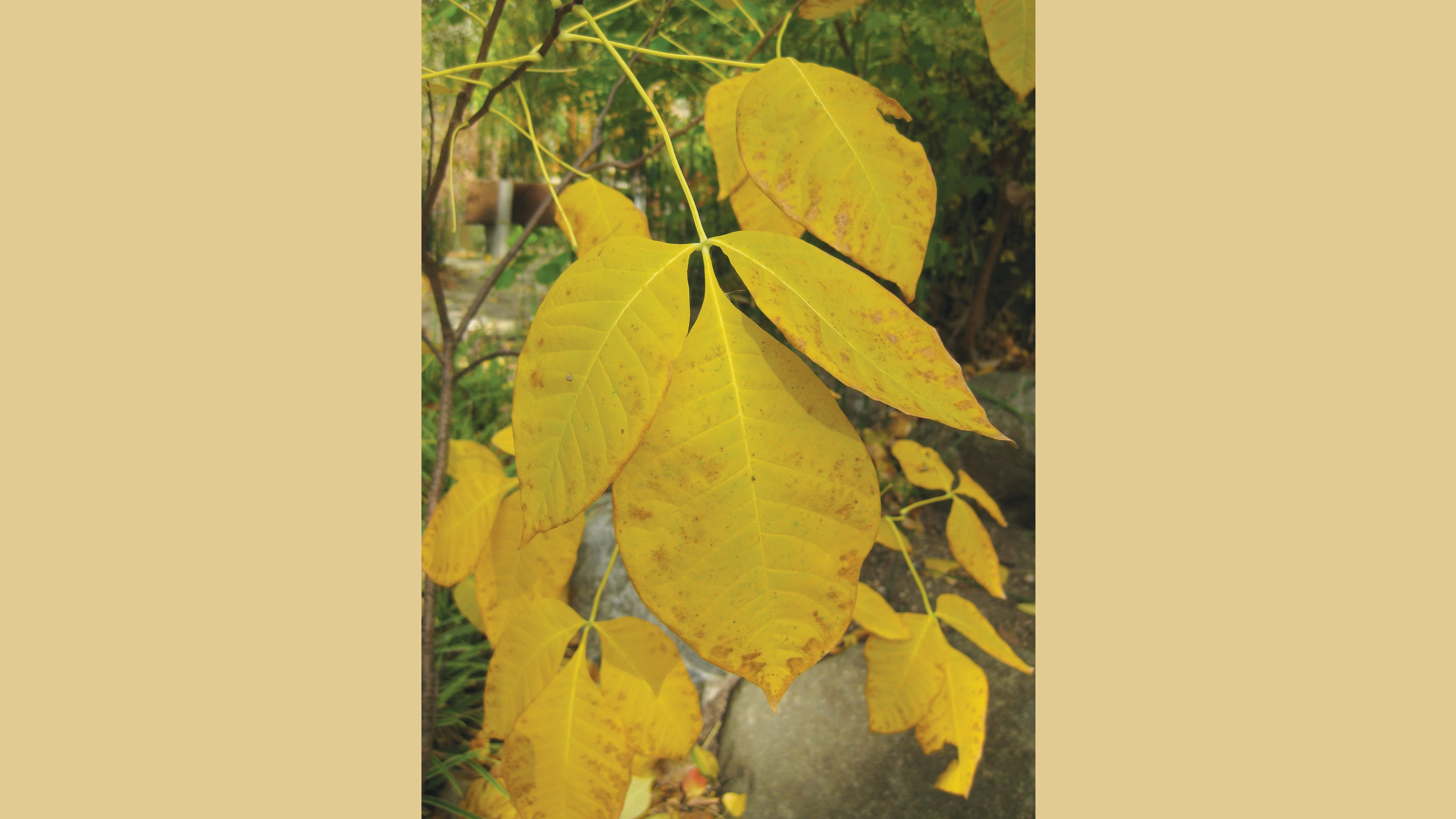
While the small, greenish-white, star-shaped, clustered flowers aren’t overly exciting in late spring, they do attract some pollinators. The flowers are malodorous (pollinated by carrion flies) and this species is also known for having a musky, unpleasant odor from the bark, crushed foliage and twigs. This certainly deters deer browsing! The primary trunks, commonly crooked, are smooth and grey in youth but will become slightly scaly with age and feature warty, corky ridges. The notable, “feather-veined,” deep-green foliage looks subtropical to me and typically gets a nice golden-yellow fall color. Ptelea trifoliata is the host plant for the giant swallowtail caterpillar, as well. For serious woody plant connoisseurs, seek the rare variety ‘Aurea’ which is a brilliant gold in spring and keeps a bright chartreuse throughout the growing season.
The seed clusters are quite ornamental. Seeds are encased in distinctively round, winged, wafer-like samaras (about 1 inch in diameter) that persist on the plant through the winter months. These seed clusters are similar to the fruiting structures on elms (Ulmus) and have a long history being used as a substitution for hops in brewing beer (hence, hop tree). Additional merits include a tolerance to alkaline and clay soils, occasional droughts and road salt. Propagation is typically by seed and semi-hardwood cuttings.

Explore the November 2025 Issue
Check out more from this issue and find your next story to read.