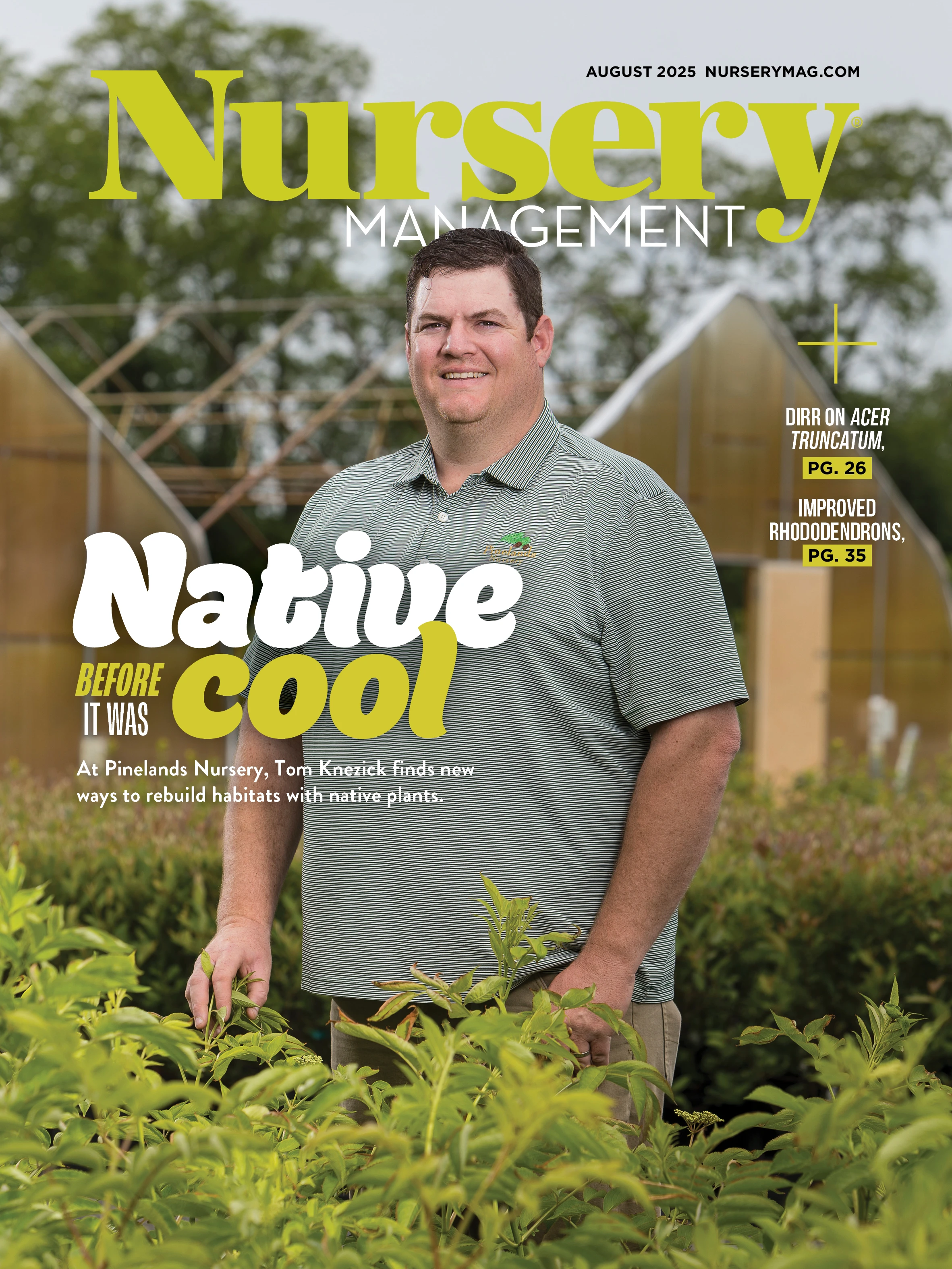
Editor's Note: This article originally appeared in the August 2025 print edition of Nursery Management under the headline “Native before it was cool.”
Editor’s note: Learn more about Pinelands Nursery under Don Knezick here and under Suzanne Knezick here.
The native plant business is booming, but that’s nothing new for Tom and Steve Knezick, second-generation leaders of Pinelands Nursery. They’ve been growing natives since before it was cool.
Don and Suzanne Knezick, Tom and Steve’s parents, founded the nursery in 1983. When legislation like the Pinelands Protection Act and the Clean Water Act began to translate into natural resource restoration projects in the late ‘80s, the business pivoted to native plant production to fill the need for plants for these projects. It’s been a successful niche, and the New Jersey nursery has grown into one of the largest native plant nurseries in the U.S.

Although Tom grew up at the nursery, he didn’t always intend to work there. However, he had a realization around the same time as his younger brother, Steve, who was in college as well. "I started thinking, 'You know, we’re passing up a good opportunity to go back and work for the nursery. Wherever we want to be in life, that’s probably a better starting off point than just trying to make it on our own,'" Tom says.
He graduated from State University of New York, Cobleskill with a degree in agricultural business and management and started working at Pinelands in June 2014.


Becoming a leader
Don retired in 2019, and Suzanne spent a year in the role before Tom took over as president of Pinelands Nursery in 2020. The two brothers have a solid working relationship.
“If it were up to me, we’d be trialing everything and growing everything,” Steve says. “We would be spread way too thin. Tommy’s a numbers guy. He crunches numbers and does a lot of analytical research.”
Tom, 36, isn’t averse to making a big move for the business, but he wants to see the data first.
“That’s where we provide a lot of good balances,” Tom says. “We both have a lot of ideas, but what’s the return? If we were to buy this thing, what do we actually get out of it?”

Steve says the brothers’ best investment is in their employees, whether that’s making sure they’re paid well or being flexible in managing them.
One of the pluses of taking over a legacy business is that you tend to inherit a well-established team. The downside is undoing the reputation you may have earned as a teenager. Fran Chismar, sales manager, and Glenn Rogers, propagation manager, both have been at Pinelands for 18 years. Paul Montrey, facilities manager, has been with Pinelands for 34 years — longer than Steve’s been alive.
“You have these people who saw you grow up — and saw you screw up — and probably heard a lot of bad stuff about us as kids. Well, more about him than me," Tom says as he laughs and gestures at Steve. "It was nice that I had pre-existing relationships with the people there, but they knew me as a kid, not as an ambitious professional. And I wasn’t the best employee when I was doing summer work, so I had to prove to them that I could be good at this and I wasn’t just the owner’s son.”
Joining the EAGL program — the Executive Academy for Growth & Leadership — in 2017 was a major turning point in Tom’s career. The one-year program was specifically designed for nursery and greenhouse growers to improve their business skills and develop strategic plans for their companies.
The invite originally went to Don. But because of his age, Don wasn’t sure he was a good fit. He said, "It’s kind of wasted on me, but if you go, you’re going to have a career out of this.”
Tom says when they got the price tag, his dad was hesitant. But Tom thought of it as an investment. He said, “If you don’t pay for me to go, I’m going to pay for myself to go” because he felt it was something the nursery really needed.
The experience of learning not just from Charlie Hall but from his fellow class members supercharged Tom’s excitement for the business.
It also highlighted the importance of having a network. Tom has volunteered to serve on the boards of many industry associations. He sees it as an opportunity to give back to the industry and make connections. And it helped people take him a little more seriously as a youngish nurseryman. They got so much out of the program, Steve joined the 2019 EAGL cohort.

Unexpected customers
Tom has a great appreciation for his parents, Don and Suzanne.
“They put so much blood, sweat and tears into starting a new business,” he says. “And even if you give it everything, so many of them fail just because the market is not ready for it. They were just so persistent, and there was enough of a market that they were able to form a foothold.”
However, that doesn’t mean that he and Steve will keep the business exactly as it was when their parents ran the place. Pinelands has grown to a nearly 40-employee operation.
“We’re not a small nursery anymore,” Tom says. “We’re getting pretty big, and we’re going to have to figure out how to take the next step to scale so that we can do more and not have to kill ourselves doing it.”
Under Don and Suzanne, Pinelands was the supply store for restoration projects. That included erosion control materials. But that market became competitive, and Pinelands’ sales in the segment started declining.
“Looking at the numbers and the effort, I thought if we took the effort we were putting into erosion control and put it back into the nursery, we’d get a better return, and we did,” Tom says.
One factor is the push from consumers for more native plants.
“Even before COVID, we saw that demand for native plants was increasing,” Tom says. “We were trying to figure out how to capture some of that homeowner business in a way that works for us.”
Steve was pushing for retail, but Tom didn’t love the idea of doing it themselves. Creating a retail-ready line would take a ton of resources and set Pinelands up in direct competition with much bigger nurseries.
That’s when the idea hit to think of those nurseries as a potential new customer base. Pinelands isn’t shifting away from the restoration market, but the nursery has started growing liners for other nurseries who are starting to get into natives.
“We used to see it as a threat, but now we’re looking at it as a great opportunity to provide liners to these other nurseries and educate them from what we know about native plants,” Steve says.
“What made the most sense was to take our existing products and showcase how it can work for them,” Tom says. “They're already working with vendors that were similar to us. We had something a little more unique in that it's all seed-grown from seed we collected ourselves. It’s local to the Mid-Atlantic and Northeast, we had some species that were a little bit outside the realm of what they were looking for, and it just happened to align when those conversations started to happen with feedback from their customers.”
Since 2016, Pinelands has sold local ecotype wildflower seed for restoration projects, meadows and retention basins. The seed is all wild-collected, received from Pinelands’ seed plots throughout New Jersey, Virginia and New York. A couple pounds each of the 70 species of seeds the nursery sells are kept in a walk-in cooler used for mixing and sales. The lion’s share of the harvested seed is kept in a “reefer” trailer that has been retrofitted to be a seed storage cooler.
This part of the business began to supply restoration contractors with the seed they needed to create meadows and retention basins. Many of the seed mixes contain long lists of plant seeds, again all collected locally and appropriate for their region. For appropriate levels of meadow diversity, the target is 20 to 25 species at a minimum, Tom says.
Everything in the coolers is labeled by collection site. Pinelands uses different colored labels, so they can identify and tell customers the source. Acquiring so much wild seed wouldn’t be possible without partnerships. Federal organizations and private land stewards have given permission for Pinelands to collect seed.
“Around the end of June, we’ll go into the Delaware River mud flats at low tide and collect species of wetland plants,” Steve says. “We’ll slop around and collect as much seed as we can.”
The seed they collect doesn’t just go into mixes for customers; it’s used to propagate Pinelands’ own plants. The nursery produces 300 species of native plants on 30 acres. The seed business has grown to about 70 acres of production.

An easy mode for meadows
One way Tom and Steve are bringing new ideas to the nursery is their partnership with Meadow Lab. The product, Wildflower Sod, is designed to be a much easier way to create a wildflower meadow. The sod consists of established wildflower plants on a natural root mat. Meadow Lab President Claire Chambers reached out to Tom to see if he knew anyone in the U.S. who could be a good growing partner. They had the recipe; they’d been doing it successfully in the U.K. for years.
“As they were describing what they need, eventually 60 acres, relatively flat land, native plants, I started thinking, ‘We’re the perfect fit for this,’” Tom says.
Pinelands can use its own seed in their blend for true local ecotype native wildflower mixes. They began in May using a seven-acre field as the starting point.
Being as locked into the ecological restoration and native plant world as they are, Pinelands doesn’t get to sell flashy new cultivars like other ornamental plant nurseries. So, being able to talk with landscape designers about an actually new native plant product has been exciting.
“There’s not a lot of new stuff that pops up in the native plant world,” Tom says. “These plants we’re selling have been around for tens of thousands of years. What’s available on the market has been the same for 100 years, or since the nursery industry took off.”
Planting a meadow by seed requires months or even a year of site prep. Then, there is a ton of maintenance to be done over the first few years to make sure that seed establishes along with the difficulty of keeping undesirable weeds at bay. There is certainly interest from customers who don’t mind paying more for a relatively no-fuss meadow in a matter of weeks.
“It’s almost like an easy button,” Tom says. “With seeding, there’s a huge knowledge gap if you want to be successful. With this, you know an expert designed it, and if you’re in the Mid-Atlantic or Northeast, it’s probably going to work for your environment.”
Fran makes the analogy, “Imagine if you wanted to use a computer but in order to do so, you had to design and build it yourself before you could access that information. Now Apple has brought you a laptop. That’s what you want: someone who figured it out, made it accessible and made it beautiful.”
Editor’s note: Visit Meadow Lab or listen to episode 265 of the Native Plants, Heathy Planet podcast for much more information.
Tom is continually evolving the nursery, and he is proud to supply plants for environmental restoration projects, making the world a greener place.
“I constantly paraphrase Aldo Leopold’s quote: ‘Being an ecologist is like living in a world of wounds.’ You’re constantly seeing the issues we’ve caused, and we’re trying to say, ‘It’s not too late; we can fix this if you put forth the effort.’”
Watch a video of Tom from the Horticultural Industries Leadership Awards at Cultivate'25 here.
Explore the August 2025 Issue
Check out more from this issue and find your next story to read.