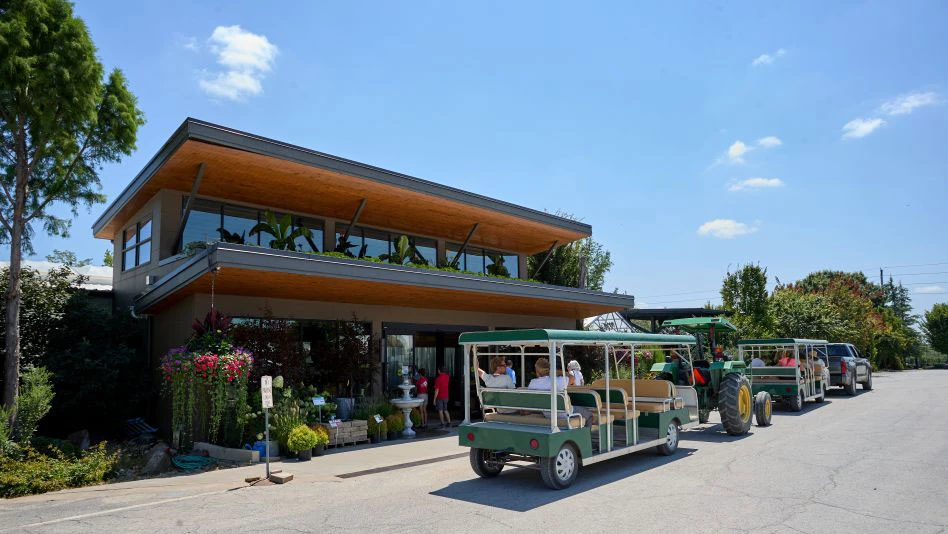
The people at Carlton Plants have been doing a lot of reflecting this year. It’s the nursery’s 125th anniversary, and when you’ve been in business that long, you can bet that you’ve done some things right.
Jason Bizon, sales manager for Carlton Plants, says that one of the nursery’s keys to success is keeping a constant focus on vision statements. Not only the company’s vision, but the individual visions of each employee, and how they relate to the company’s identity and goals.
“That’s a big part of our longevity, our identity, not chasing fads or false demands,” Bizon says. “We try to always take the approach of building the demands and letting the market come to us.”
The business tries to model itself as good stewards of the land. In 2010, Carlton Plants won the inaugural Outstanding Environmental Stewardship award from the Oregon Association of Nurseries. The nursery’s philosophy toward sustainability is progressive, productive and practical. Cover crop rotation, resting fields, drip tape irrigation and composting are some examples of the nursery’s Earth friendly initiatives.
Oregon is well known for its ahead-of-the-curve recycling. Carlton Plants is a fine example of an Oregonian business in this regard, as the nursery uses waste from several area businesses in its composting process, starting with its own unsold trees.
“It’s a good way for us to get rid of the trees and the local dairies to get rid of manure, local wineries to get rid of grape crushings and the cherry plant to get rid of cherry pits,” Bizon says. “We think there is value in using up things that are readily available to us and the crop area around us. Rather than taking it to the dump, we’re putting it to good use, putting it back out on the fields.
“It may sound cliché but we want to leave the ground better than we found it. Whether it’s rented or owned ground, we are in constant motion for better environmental impacts that positively reflect our beliefs, not only in business but in our personal lives. We take great pride in our own personal spaces like our gardens or landscapes. Why would that be different in our professional lives?”
Another way the nursery has practiced sustainability is through focusing on water. During the last 10 years, Carlton Plants has moved away from overhead irrigation. Now, about 65 percent of the nursery’s crops are drip irrigated. The plastic T-Tape is buried in a row, and nursery workers plant next to the tape. Every three or four years, the tape is dug out, washed and recycled. Bizon says the drip tape curtails the wasteful impact of overhead sprinklers and booms, and puts water right where the plant needs it.
“From an environmental and production standpoint, it’s a very effective way of getting water to our crops,” Bizon says. “We’ve seen it in the quality of trees and shrubs. They respond better to having that water on the root zone.”
Drip irrigation improves production efficiency, too, because the nursery can have employees working in the field and watering its crops at the same time.
“You don’t have to move your people because the big gun is coming through,” Bizon says. “Your water loss through evaporation is way less.”
For more: www.carltonplants.com

Explore the September 2015 Issue
Check out more from this issue and find your next story to read.
Latest from Nursery Management
- The Growth Industry Episode 10: State of the Horticulture Industry
- Tennessee Green Industry Field Day scheduled for June 11
- UTIA and UT Knoxville research teams will develop automated compost monitoring system
- Ken and Deena Altman receive American Floral Endowment Ambassador Award
- [SNEAK PEEK] Leading Women of Horticulture: Becky Thomas
- [SNEAK PEEK] Leading Women of Horticulture: Angela Burke
- [SNEAK PEEK] Leading Women of Horticulture: Alexa Patti
- Native before it was cool