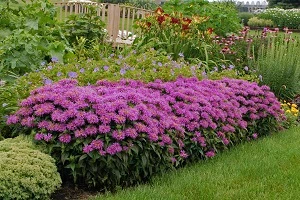
 A colorful native perennial that attracts pollinators, butterflies, and hummingbirds and can cure your headache too? That’s monarda, commonly known as bee balm or bergamot. Its brilliant red, pink, and purple flowers perched atop the tall, square-stemmed foliage light up the landscape in midsummer. Its foliage, when steeped in boiling water and then consumed, has been known to cure headaches and even fevers.
Native species and modern cultivars
Monarda has literally been around for centuries and is still considered a standard in perennial production and gardens today. The native M. didyma produces scarlet red flowers on stems up to six feet tall, while the shorter M. fistulosa and early blooming M. bradburiana both produce lavender to pink blossoms. Hybrid monardas come in shades of red, violet, purple, pink, and white. Classic selections such as ‘Gardenview Scarlet’ and ‘Jacob Cline’ continue to be the standard in tall reds, as there has yet to be a true red dwarf selection discovered or developed. ‘Purple Rooster,’ ‘Raspberry Wine,’ and Grand Parade set the standard in true purple Monardas, while ‘Marshall’s Delight’ and ‘Pardon My Pink’ rank high on the list of pink cultivars.
Monarda trial results
Richard Hawke of the Chicago Botanic Garden conducted a trial of Monarda and its powdery mildew resistance from 1993-1996. Though hybrids are often affected by powdery mildew, he found the following varieties to exhibit good resistance: ‘Colrain Red,’ ‘Gardenview Scarlet,’ ‘Marshall’s Delight,’ ‘Raspberry Wine’ and ‘Violet Queen.’ He offers these recommendations for improving the monarda performance: “Powdery mildew can be lessened by selecting mildew-resistant cultivars, increasing air movement between plants, minimizing overhead watering, and removing diseased leaves each fall. Cutting stems to the ground after flowering and dividing plants every few years can further enhance plant health and vigor” (Plant Evaluation Notes, Issue 12, 1998).
 Garden culture
Monarda can be found growing naturally across a wide area of North America, most commonly in moist meadows, along rivers and streams and in forest clearings. Since is it tolerant of juglone, it can also be found growing near black walnut trees. Monarda prefers rich, organic, consistently moist soil, but it will also grow in average soil. Full sun is best, though light shade is tolerated but beware that it tends to spread more quickly there. Plants typically decline after they are finished flowering. By cutting them back to the ground in late summer, it will promote new growth.
Monarda potting and timing
Monarda is typically propagated by cuttings and sold in plug form at the wholesale level. Finish growers looking to produce a crop of 1 gallon or 2 gallon monarda have a few options. For a quick turn in spring on full sized, aggressive cultivars, start with smaller 72-count plugs and allow 8-10 weeks to finish in trade 1-gallon containers or use larger 20-count plugs to finish in 2-gallon containers in 10-12 weeks. Dwarf varieties such as ‘Pardon My Purple,’ which are less aggressive and have fewer basal shoots, require more time and heat to finish. Allow 10-12 weeks to finish from a 72-count plug in trade 1-gallon containers in spring. Pre-season bulking is especially beneficial for dwarf varieties, allowing them to develop more basal shoots resulting in fuller finished plants (see “comparison” photo). When potting up monarda plugs, use a well-drained, peat/bark soil mix with a pH of 5.8-6.4.
Fertility. Monardas are moderate feeders which prefer a constant liquid feed of 75-150 ppm Nitrogen at every irrigation. If fertilizing with a liquid feed as needed, apply at the higher rate of 150-200 ppm N. A controlled release fertilizer may also be used at a rate of 1-1.25 pound per cubic yard of growing media. Watch the EC rates on monarda and keep them between 1.5-2.5 using the pour-through method.
Moisture. Monitoring moisture levels is critically important when producing a crop of monarda. Never let the plants dry out. Water them thoroughly and maintain moderate moisture levels throughout the entire production process to build a solid root system. Be sure to water plants in the morning to allow the foliage to dry before evening to avoid issues with powdery mildew.
|
Fun facts about monarda
|
Lighting. Monarda requires long days of 16 hours or more to initiate flower production. Plants flower naturally in midsummer. To force them to flower earlier, supplemental lighting may be required.
Temperature. Taller, more aggressive varieties can be grown and bulked up at 60°F-68°F, but dwarf varieties will bulk up much quicker if grown in warmer temperatures of 68°F-72°F. Once plants are rooted out, they can be held at 50°F to maintain their compact size and prevent stretching in the pot.
Pests and diseases. Since monarda can be prone to powdery mildew, it is recommended to apply a broad spectrum fungicide drench and a preventative foliar fungicide spray at the time of transplant. This will also help to prevent root and crown rot. By selecting mildew resistant varieties, providing good air circulation, and spacing plants well, you will have fewer disease issues in production. Aphids, spider mites, thrips and whiteflies are common pests for monarda. Scout regularly for these pests and treat as needed.
Finishing tips
Pinching. About two weeks after potting up your crop of monarda, do a soft pinch to promote better branching. If starting from smaller 72-count plugs, it may be necessary to do a second soft pinch roughly 4 weeks after transplant.
PGRs. PGRs should not be used on dwarf varieties of monarda. They may be applied to taller, more aggressive varieties using a spray application of a mix of daminozide at 2,000 ppm and uniconazole at 3 ppm. This should be applied about one week after pinching once the foliage begins to regrow.
Forcing. Monarda is cold beneficial, but not required, meaning it will bloom without vernalization but plants will have more flowers if the plants have been vernalized. If vernalizing your finished plants for forcing, keep them at 40°F or colder for 6-9 weeks. If growing a quick finish crop for spring, start with vernalized plugs. When forcing plants to be in bloom for spring sales, grow them at 68°F-70°F for 9-11 weeks (timing varies somewhat by variety).
Jeremy Windemuller is trial manager at Walters Gardens Inc. and owner of Windridge Greenhouse, a retail operation in Zeeland, Mich. Susan Martin is director of marketing at Walters Gardens Inc. and an avid perennial gardener. Learn more about monarda at www.WaltersGardens.com and www.ProvenWinners.com.
Photos courtesy of Susan Martin

Explore the September 2013 Issue
Check out more from this issue and find your next story to read.