EPA proposes changes to worker protection standards
New regulations affecting flower and plant growers were announced in February by the EPA when it issued proposed revisions to the long-standing Agricultural Worker Protection Standards (WPS).
The EPA is proposing changes designed to increase worker training on the safe use of pesticides and expand protections from pesticide exposure for agricultural workers including those who work in greenhouses and nurseries.
The proposed changes include increased frequency of mandatory trainings (from once every five years to annually) to inform farm workers about the protections they are afforded under the law, including restrictions on entering pesticide-treated fields and surrounding areas, decontamination supplies, access to information and use of personal protective equipment. Expanded trainings will include instructions to reduce take-home exposure from pesticides on work clothing and other safety topics.
The proposal includes expanded mandatory posting of no-entry signs for the most hazardous pesticides; the signs prohibit entry into pesticide-treated fields until residues decline to a safe level.
Also included for the first time is a minimum age requirement: Children under 16 years old will be prohibited from handling pesticides, with an exemption for family farms.
No-entry buffer areas surrounding pesticide-treated fields will protect workers and others from exposure from pesticide overspray and fumes.
The proposed changes includes measures to improve states’ ability to enforce compliance including requiring employers to keep records of application-specific pesticide information as well as farmworker training and early-entry notification for two years.
Personal Protection Equipment (respirator use) must be consistent with the Occupational Safety & Health Administration standards for ensuring respirators are providing protection, including fit test, medical evaluation, and training.
You can submit comments on the proposed standards at www.regulations.gov under the docket EPA-HQ-OPP-2011-0184-0002.
AmericanHort renames annual convention and trade show
AmericanHort announced that its annual convention and trade show has been renamed Cultivate – An AmericanHort Experience. Formerly known as OFA Short Course, Cultivate’14 will continue to offer premier educational and networking experiences, and more than 7 acres of trade show exhibits including technology, new products and services, and new plant varieties. This year also sees an expansion of products and services for retailers, nursery production, and landscaping. Thousands of attendees from more than 20 countries are expected.
Considered to be the largest horticulture trade show in North America, Cultivate’14 will be held in Columbus, Ohio on July 12-15, 2014. Cultivate’15 will be held on July 11-14, 2015, and the future events are scheduled in Columbus, Ohio each July through 2018.
For more: www.AmericanHort.org/Cultivate
Nine growers complete inaugural EAGL program
Nine growers completed their one year Executive Academy for Growth & Leadership (EAGL) program for nursery and greenhouse growers, receiving a continuing education Certificate in Applied Horticultural Business Management from program partner Texas A&M University.
The EAGL program is the first of its kind public-private partnership specializing in strategic business skills for commercial horticulture.
The growers are Bryan Abramowski, Rockwell Farms, Dan Batson, GreenForest Nursery, Tom Demaline, Willoway Nursery, Randy Gilde, Delray Plants, Kelly Lewis, Ruppert Nurseries, Kevin Norris, Landmark Nurseries, Ed Overdevest, Overdevest Nurseries, Jason Roseman, Rockwell Farms, and Mark Sellew, Prides Corner Farms.
A second EAGL class has already begun its coursework, with planned graduation in January 2015. Applications for the 2015 EAGL class will open in June 2014, with a maximum of 15 seats available. Direct competitors are not accepted in the program in the same year.
For more: www.eaglpro.com.
USDA inventories wild species
ARS researchers and their collaborators have finished a first-of-its-kind inventory of wild relatives of important crops indigenous to the U.S. or that have become naturalized to aid in the conservation of their genetic diversity.
According to USDA’s Agricultural Research Service (ARS), the inventory was created to aid the conservation of these so-called “crop wild relatives” (CWRs) and ensure their availability as prized sources of genetic diversity for an array of economically important traits, including improved drought tolerance and resistance to pests and diseases.
All told, the inventory covers 4,596 taxa from 985 genera and 194 plant families that are either indigenous to the United States or have become naturalized—established of their own accord following human introduction.
For more: www.ars.usda.gov/is/AR/archive/jan14/crops0114.htm
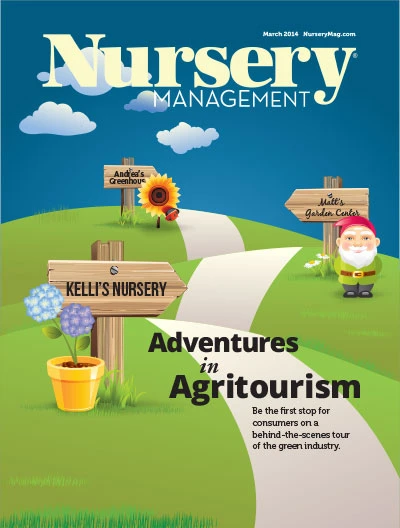
Explore the March 2014 Issue
Check out more from this issue and find your next story to read.
Latest from Nursery Management
- [SNEAK PEAK] Leading Women of Horticulture: Louise Schaefer and Susan Tantsits
- The Growth Industry Episode 10: State of the Horticulture Industry
- Tennessee Green Industry Field Day scheduled for June 11
- UTIA and UT Knoxville research teams will develop automated compost monitoring system
- Ken and Deena Altman receive American Floral Endowment Ambassador Award
- [SNEAK PEEK] Leading Women of Horticulture: Becky Thomas
- [SNEAK PEEK] Leading Women of Horticulture: Angela Burke
- [SNEAK PEEK] Leading Women of Horticulture: Alexa Patti