 A scientist from the University of Rhode Island’s Biocontrol Lab released thousands of parasitic flies last summer in an effort to combat an invasive moth that is defoliating trees throughout the state. Heather Faubert, coordinator of URI’s Plant Protection Clinic, says that the caterpillars of winter moths, which are native to Europe and arrived in Rhode Island in the last decade, were found last year in large numbers in many of the state’s coastal communities, as well as in inland areas like Lincoln and Cumberland.
Because the moths have no known predators in the region, Faubert has worked with colleagues at the University of Massachusetts to rear and release a parasitic fly, Cyzenis albicans. It has successfully reduced the moth population in Nova Scotia, where the moths were first found in the 1950s. The fly lays its eggs on tree leaves, and when the moth caterpillar eats the leaves, it ingests the eggs. The fly larva grows inside the caterpillar and consumes it from the inside.
“I’ve been working on this project since 2005 when our winter moth populations were quite low,” says Faubert. “You need large populations of the moths for the flies to do their job, so I spent several years scouting around the state looking for large moth populations.”
Faubert released about 1,600 parasitic flies at Goddard Park in East Greenwich in 2011, followed by releases in Bristol and Jamestown in 2013 and in South Kingstown, Cumberland and Jamestown last summer. It takes several years for the fly population to establish itself in an area to make a noticeable impact on moth numbers.
Winter moths attack a number of ornamental trees including oak, maple, birch and hickory, but in Rhode Island, Faubert’s greatest concern is for commercial growers of apples and blueberries.
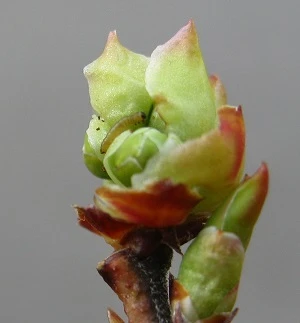
“The moth eggs begin hatching around the middle of April, when there is very little food for them, so they crawl into buds and begin feeding until the bud opens,” potentially destroying an entire crop, she says.
The first report of winter moth caterpillars in Rhode Island came from a Warwick blueberry grower in 2004, and Faubert has been advising commercial growers about the threat ever since.
How to identify winter moth
|
 Winter moth caterpillars are pale green with a faint white longitudinal stripe running down both sides of the body. They have just two pairs of prolegs. The male moths are light brown to tan and all four wings are fringed with small elongate scales that give the hind margins a hairy or fringed appearance. The female is gray, almost wingless and, therefore, cannot fly. Eggs are green at first, but turn red-orange soon thereafter. In March, just prior to hatching, the eggs turn a bright blue and then a very dark blue-black before hatching.
“More and more commercial growers are being affected, so I tell them that they should spray insecticide earlier in the season than they normally would,” Faubert said.
Faubert reports seeing some level of winter moth control in the state, which she attributes to the parasitoids. She plans to continue releasing the parasitic flies at different sites around the state for several more years.
“Hopefully within about five years the population of flies will increase and they’ll take care of the problem.”
Winter moth injury
|
 Young larvae wriggle into buds of host plants in the early spring just before or at bud break. Once inside the buds, the tiny caterpillars begin feeding. Delayed bud opening due to cool weather can lead to bud death. Larvae move from bud to bud as they feed. As the larvae grow, they feed in expanding leaf clusters and are capable of creating defoliation in high populations.

Explore the February 2015 Issue
Check out more from this issue and find your next story to read.
Latest from Nursery Management
- [SNEAK PEAK] Leading Women of Horticulture: Louise Schaefer and Susan Tantsits
- The Growth Industry Episode 10: State of the Horticulture Industry
- Tennessee Green Industry Field Day scheduled for June 11
- UTIA and UT Knoxville research teams will develop automated compost monitoring system
- Ken and Deena Altman receive American Floral Endowment Ambassador Award
- [SNEAK PEEK] Leading Women of Horticulture: Becky Thomas
- [SNEAK PEEK] Leading Women of Horticulture: Angela Burke
- [SNEAK PEEK] Leading Women of Horticulture: Alexa Patti