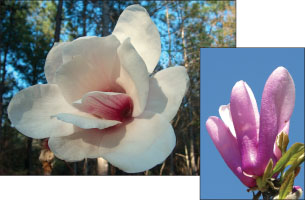
 Flowers on ‘Jon Jon’ (left) begin goblet shaped and open to a cup-and-saucer shape with age.‘Jane’ (right) has reddish-purple flowers with a white inside. Flowers are a tulip shape with a lightly scented fragrance. Large, elegant blossoms of white, pink or reddish purple make the magnolia one of our most beloved spring-flowering trees.
Unfortunately, this magnificent display of flowers can be ruined by an untimely freeze. The best recent example of this was during 2006-2007 in the East when the unseasonably mild winter forced many magnolias into early bloom. Open flowers were subsequently damaged by normal low temperatures that resumed in early spring. Only late-flowering magnolias escaped this damage.
Plant right to avoid damage
Weather is unpredictable, so planting magnolia selections that flower later can help to avoid frost and freeze damage. To identify which cultivars are late-flowering, I used data from a magnolia evaluation planting at the University of Florida’s North Florida Research and Education Center in Quincy, Fla. Quincy is in USDA Hardiness Zone 8b and AHS Heat-Zone 9.
 This side-by-side planting of more than 50 cultivars provides a good comparison of flowering times since all cultivars are exposed to the same conditions. Thanks to help from volunteers, we have recorded the number of flowers on each magnolia weekly, year-round, since 2003.
 ‘Leonard Messel’ (top) features flowers with 12 straplike petals that are creamy-white inside and suffused with pink outside.‘Marillyn’ (bottom)has large, slightly-fragrant, tulip-shaped, purple flowers.
The flowering data allowed us to determine date of peak flowering — the date on which the maximum number of flowers was recorded each year. “Flower” for our counting purposes includes flowers in all stages, including flower buds showing color. To further validate flowering comparisons, we only evaluated cultivars having 20 or more flowers open at one time at least once per year during three of the past five years.
Using these criteria, mean date of peak flowering was calculated for 35 selections. Table 1 lists selections derived from Magnolia stellata ranked by mean date of peak bloom at Quincy, Fla. Table 2 lists deciduous selections derived from additional Magnolia species and hybrids other than Magnolia acuminata (cultivars derived from M. acuminata naturally flower in late spring, so they’re excluded from this analysis).
Dates of peak flowering for cultivars listed in Tables 1 and 2 should be similar in other locations along the Gulf Coast and would occur progressively later moving north. Data in Table 2 contributes information on some hybrids not easily classified into a group.
Best bets to avoid freeze damage
Based on these data, I can recommend a number of late-flowering cultivars to avoid frost damage: ‘Leather Leaf,’ ‘Jon Jon,’ ‘Marillyn,’ ‘Ann,’ ‘Athene,’ ‘Leonard Messel’ and ‘Jane.’ No single heritage or breeder appears associated with these trees.
Thankfully, members of this group represent a wide range of sizes, shapes and colors. Flower color ranges from white (‘Leather Leaf’ and ‘Jon Jon’) to pink (‘Leonard Messel’) to reddish-purple (‘Marillyn’). Flower shapes vary from the multi-tepalled, flat flower of ‘Leonard Messel’ to the elegant cup-and-saucer of ‘Athene’ and the upright flower of ‘Marillyn.’ The flowers of ‘Jon Jon’ begin goblet shaped and open to a cup-and-saucer shape with age. Flower size ranges from the 4-inch flowers of ‘Ann’ and ‘Leonard Messel’ to the amazing flowers of ‘Leather Leaf’ and ‘Jon Jon’ that are up to 12 inches across.
Plant form extends from the shrubby habit of ‘Ann’ and ‘Jane’ to the treelike ‘Athene’ and ‘Jon Jon.’ With such diversity, there’s a late-flowering magnolia for nearly every desire.
Gary W. Knox is an extension specialist, University of Florida, Institute of Food and Agricultural Sciences, North Florida Research and Education Center, Quincy, Fla.; gwknox@ufl.edu.
Explore the September 2009 Issue
Check out more from this issue and find your next story to read.