Photos: Mark Dwyer
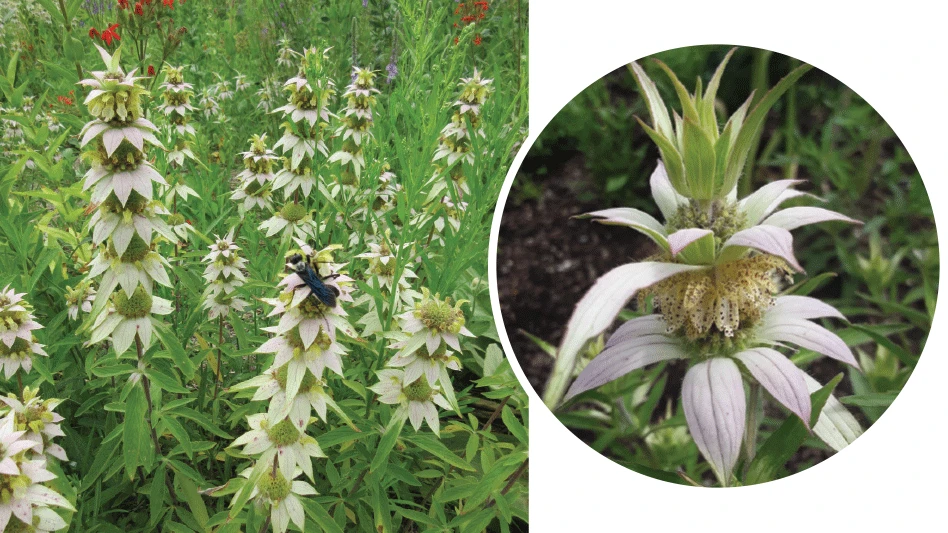
I’ve become quite smitten with spotted beebalm which is native primarily to the eastern U.S. While typically found in sandy habitats and oak savannas, this short-lived selection exhibits an amazing ornamental contribution in the landscape. I’m using this clump-forming species extensively in a large pollinator garden and it’s the most frequently asked about plant when in bloom (12-36 inches in height) in late June until early September. Full sun is ideal although part sun is acceptable. Bees, wasps, butterflies and hummingbirds also greatly appreciate the presence of this native in the landscape.
The flowers, arranged on multiple stems, present themselves in whorls on dense, elongated spikes which also display very colorful bracts. When viewed from a closer proximity, the radially-arranged flowers are a creamy yellow to beige with maroon-purple spots. The stacked inflorescences have leafy bracts that radiate from the stem, just below the flowers. The bracts can be bright pink to silver and provide ornamental interest from both near and far. The flower architecture is exquisite as a design element with groupings becoming quite impactful. Flowering duration is minimally six weeks with the bracts contributing extended interest. More frequent moisture during dry spells can help prolong the flowering period.
The aromatic foliage of this mint family member has the fragrance of oregano when crushed and both deer and rabbits are “browsing-adverse.” Spotted beebalm has decent mildew resistance but will suffer similar setbacks typical of other beebalms in cooler, wet summers. Good air circulation is recommended. Drainage is vital in planting locations, and while drought tolerant once established, consistent moisture for this species is ideal. Well-sited specimens will thrive and some reseeding isn’t unusual. Spotted beebalm is typically propagated by seed or cuttings. The variety ‘BeeBop’ is consistently compact at a blooming height of 18 inches or so. Despite being considered “short-lived,” the colonies of spotted beebalm that I’ve nurtured appear to be self-perpetuating and the ornamental contribution of this underutilized perennial cannot be overstated.
Explore the October 2024 Issue
Check out more from this issue and find your next story to read.