
MrMaple.com
Matt and Tim Nichols are the two brothers behind MrMaple.com, a North Carolina-based mail-order nursery that specializes in Japanese maples — with more than 1,500 cultivars available to be shipped anywhere in the U.S. They are also the faces you see most often on the MrMaple Show, their YouTube channel which is updated daily with fresh content for nearly 40,000 subscribers. It all started with an obsession with the Japanese maple.
“We’re hoarders and collectors naturally,” Matt says. “I grew up collecting shoes and comic books and all kinds of things.”
Norman Nichols, their father, started selling Japanese maples as a hobby in 1974, but the Nichols family’s fascination goes back even further. Their grandmother on their mother’s side started growing Japanese maples from seed in the 1950s.
“Dad married into some good rootstock,” Matt says.
Norman worked for General Electric and sold his maples at weekend tailgate markets. Matt and Tim spent a lot of weekends selling maples with their dad, and they also helped their grandmother with her garden. In 2008, the brothers decided to take their father’s hobby and turn it into a business.
“Early on, when we were collecting maples before we ever thought about doing this as a business at all, Tim and I would say ‘Dad, we’ve got a new tree for you.’ And he’d say, ‘Guys, I’ve got 100.’ And I’d say, ‘But you need this one. Look how different this one is.’”

Origin story
Norman taught himself to graft and shared the art with his children. Matt and Tim learned to graft maples in their parents’ basement. During those tailgate market weekends, they hoped to sell enough trees to cover gas money to get home.
While they’d sit at those markets, the brothers would read all the books about Japanese maples they could find.
In 2009, Matt and Tim were beginning to grow the business out of their parents’ basement when they received an invitation that would change their lives. When they were asked to visit Oregon for a Maple Society meeting, they had to have a yard sale to afford the plane tickets. But the brothers say one of the highlights of that trip was getting to visit Buchholz Nursery, home of the Flora Wonder Arboretum, and meet Talon Buchholz.
It’s still hard for them to believe they own the place. But that’s exactly what happened after the brothers’ September 2023 acquisition of the Gaston, Oregon nursery.
“Talon was a mentor to us,” Tim says. “The opportunity to buy Buchholz Nursery allowed us to be able to offer Japanese maples to garden centers all across the country. That’s opening a new route for us.”
The Nichols brothers decided to keep the businesses separate and continue Oregon operations as Buchholz Nursery, in part because of the name recognition of the legendary nurseryman.
“Talon Buchholz, for us, he’s the Michael Jordan of maples,” Matt says. “He’s the guy who named more cool varieties than anybody. We’re honored just to try to continue on that legacy.”
Talon signed a one-year contract to stay at the nursery through the transition. After that contract ended, Talon decided to stick around on an hourly rate just doing the parts of the job that he likes: cutting scionwood, overseeing propagation.
Crash course in wholesale
The acquisition was challenging for Matt and Tim, because MrMaple was a retail business. They didn’t have experience running a wholesale nursery. So they weren’t about to jump in ready to change everything right away.
“Buchholz Nursery was successful without us,” Matt says. “MrMaple is successful without Buchholz. So let’s keep those two things what they are and let them do what they’re really good at. That’s been a focus here from the get-go, trying to be the best version of each.”
However, the brothers did have some immediate goals for the wholesale nursery. Near the end of his career, Talon sold off much of the Buchholz Nursery’s inventory. When the brothers bought the nursery, they wanted to scale it back up.
“He never had a problem selling out,” Matt says. “He just needed more. So our goal is to get (Buchholz Nursery) more and hopefully the market responds to us.”
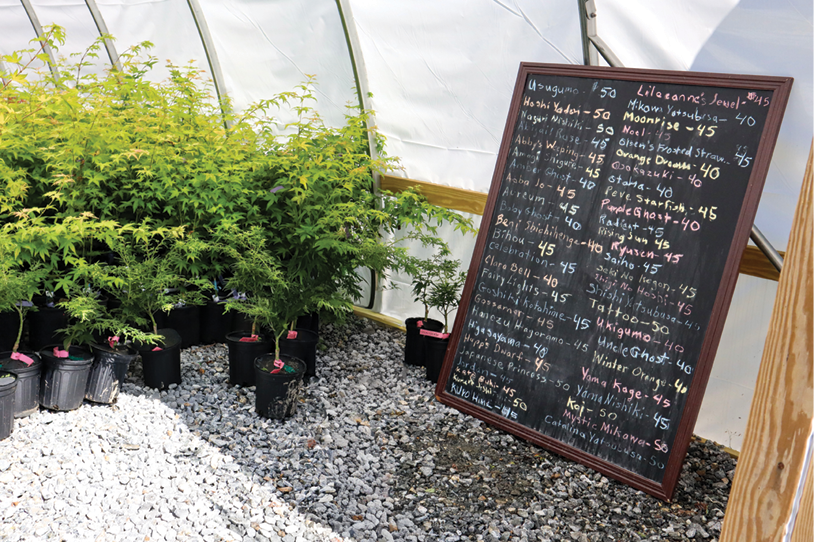
It’s been a challenge to rebuild supply, but now, the property is full, with more 7-gallon maples and more conifers available than ever before.
Having more plants available and in bigger numbers is no easy task, especially when you’re propagating by grafting. Matt and Tim can’t help but gush when discussing the team at Buchholz.
Joel Johnson, a nurseryman with 25 years of experience running much bigger operations, heads up the Oregon site. Tim says he and Matt have one or two weekly conference calls with the staff at Buchholz, and daily check-ins with the managers. Although they go to Oregon several times a year now, they don’t worry about managing day-to-day operations.
“We have such a good staff that I don’t have to be on top of them all the time,” Matt says. “We get to call the plays and make sure we’re producing the plants we want.”
The brothers only have 4 acres in North Carolina, so adding 25 acres in Oregon allows them to increase production numbers for some of their top sellers.
But despite their name and reputation, it’s not all maples for Matt and Tim. Dogwoods, camellias and ginkgos are other popular plants. In Oregon, the nursery has been beefing up its conifer numbers, especially in winter propagation.
Other changes with Buchholz under new ownership include a fresh, frequently-updated inventory page for wholesale customers to access.
Generating hype
Matt and Tim are using their experience running “plant drops” on MrMaple.com to determine which cultivars need a production boost. They believe IGCs will jump at the opportunity to purchase standouts like Strawberry Springs and Ikandi at wholesale prices and quantities.
“Things that sell out in seconds on MrMaple, they’ll be able to find them, get them to their customers and get that same kind of hype and excitement going at their garden center,” Matt says.
The MrMaple plant drops are as hectic as you’d expect. Every Tuesday and Thursday at 10 a.m. EST, 10 new trees that were previously not on the website are added. Some may have been sold out; some could be first-time listings. Behind the scenes, the MrMaple team builds descriptions, photos and the purchase links. Plants often sell out by 10:05 a.m. Once customers place orders, the team immediately ships them out.
“We know the demand’s there,” Tim says. “Things like Geisha Gone Wild have become a staple in the nursery trade that everyone has to have. That was an introduction by Talon Buchholz, probably one of his more popular varieties behind or maybe even in front of the Ghost series. It’s one of those trees that now everyone’s chasing after.”
The brothers believe the diversity available through the MrMaple/Buchholz pipeline will be an asset to Buchholz’s customers.
“If you’re a garden center, think about it this way,” Tim says. “Do I want to have to find 100 customers and sell them the same tree? Or do I want to find one or two customers and sell them a whole bunch of trees?”
Almost 90% of MrMaple customers return to make another purchase, Matt says. And the brothers want to continue their strategy at Buchholz: release a diverse mix for collectors to be able to shop and find not just one, but multiple trees they are compelled to buy.

Plantfluencers
The MrMaple Show (youtube.com/@MrMapleShow) has been the gateway to maple collecting for many users of the biggest online video platform. Though Matt and Tim started the YouTube channel in 2014, the channel really took off during the pandemic. Matt and Tim spent a lot of time on the garden speaker circuit, honing their communications skills and sharing their passion for Japanese maples.
“We’d be in Michigan or Kansas, all over the U.S. doing talks on Japanese maples, then COVID struck and those talks all got shut down,” Tim says. “YouTube was our way to talk to people. It just naturally became our outlet for putting out the same information we’ve been putting out for years, but in a way that is easily attainable for other people to find it.”
With regular staples like “10 new plants at 10 a.m.” every Tuesday and Thursday and a new cultivar episode every Monday, they’ve grown their channel to nearly 40,000 subscribers. Overall, their videos have more than 10 million views.
When planning their video content, Matt and Tim use a fairly simple formula. They aim to make content they would have wanted to see when they were sitting at those tailgate markets. Cultivar highlights, new plant introductions and those ever-present lists. One of their most popular show types is when they ask a collector to name their Top 5 Japanese maples.
“People love to see what other people like,” Matt says. “People come here to our open house and say ‘My top five are these, and don’t hold me to it. It might change next week.’”
It’s also a strategic move to showcase the plant collectors, who often have completely different lists than the Nichols brothers. Viewers watch to see if their favorite gets named, but it also opens their eyes to new plants.
Another avenue for finding new content ideas is the email inbox at MrMaple.com. If a question is being asked constantly, it’s a good bet that a video answering that question will be popular. So they plan it, and make a video containing that information for their customers. The goal behind the channel is not only telling people about new plants, but making sure those new plants succeed. That’s why education is another major pillar of the content programming plan.
Another popular video type is the garden tour. Viewers enjoy seeing other people’s gardens, and the Nichols brothers like to show what maples can look like in a garden setting, paired with other types of plants.
The MrMaple Show doesn’t happen without a team. Matt says there are two full-time employees producing content so that the channel is active seven days a week.

Gotta catch ‘em all
Matt likes to point to a nicely-curated list of grafted Japanese maples with diverse traits…from the 1700s.
“There was that level of sophistication for a plant that far back,” Matt says. “Even back then, there was this list of dynamic, cool plants, and it’s only evolved from there.”
“That was already a pretty good collection if you just grew the 1700s list. But now we’ve had the floodgates open up for new and interesting traits. And I like to collect them all.”
He says it’s rare for maple collectors to have one or two trees. They’ll buy a red laceleaf and open the door. But they rarely stop there. Tim agrees.
“The diversity of maples with size, shape, color, texture… it’s unlike any of the other trees,” Tim says. “You can have a dwarf that grows to 2 feet after 10 years or you can have a tree that gets to 12 feet after 10 years. There’s a large diversity in leaf shape. You can plant an entire garden full of just Japanese maples.”
Maples grow throughout most of the U.S. MrMaple has shipped to all 50 states and Buchholz has done the same, plus Canada. Matt typically gives a rating of Zone 5 through 9 on the East Coast for Japanese maples, though California can be tricky because you can grow maples in full sun in Zone 10 if the climate is mild enough.
For the most part, Matt says, Japanese maples are produced similarly, and are easy to grow. Generally grafts take at a similar rate, as well.
“You’ll get humbled some years, where you failed miserably on one specific cultivar, and you’ll find that a lot of people did all over the continent,” Matt says. “It’s weird, like everybody did bad on this one this year.”
Besides setbacks like that, growers need to be aware of different sun tolerances. Low nitrogen is the crucial fertilizer tip, Matt says. Both at MrMaple and Buchholz, they use a low nitrogen fertilizer and cut it off entirely after May, which he says gives the best success, especially in colder zones.
Most MrMaple plants are sold and shipped at 1 gallon, but Buchholz has more sizes available, ranging from 2 gallons up to 10 gallons.
The only downside to having so much variety diversity is the complexity of managing production.
“If you’re doing 50,000 to 75,000 grafts in a year, it’s definitely easier to do 20,000 Crimson Queens than go around chasing down 1,500 cultivars and try to make sure you’ve got everything in production,” Tim says.
Determining how many of each cultivar to produce is a challenge, but the Nichols brothers decide whether to graft 50 or 2,000 of a particular plant based on several factors. Tim has a tiered ranking system at Buchholz that goes from “no more grafts” up to “graft all you can.” Trees are sorted into different categories, like variegated or weeping laceleaf, and the brothers determine how many plants they need from each category.
When they graft a maple, it won’t be ready to sell as a 1-gallon plant for two years. But Matt isn’t worried about spending the 2025 grafting season speculating on the 2027 market. He trusts their intuition.
“With 1,500 varieties of Japanese maples, we have a lot to compare to,” Tim says. “We know when something is special.”
Matt and Tim are both past presidents of the North American Maple Society. They’ve traveled the world searching for Japanese maples. Through feedback from MrMaple customers and sales data, they have their fingers on the pulse of what the market is after.
“It’s almost like you’re building an album and there’s that song, you know it when you see it,” Matt says. “You're like, that's a hit. You know the ones that are going to be the stars.”
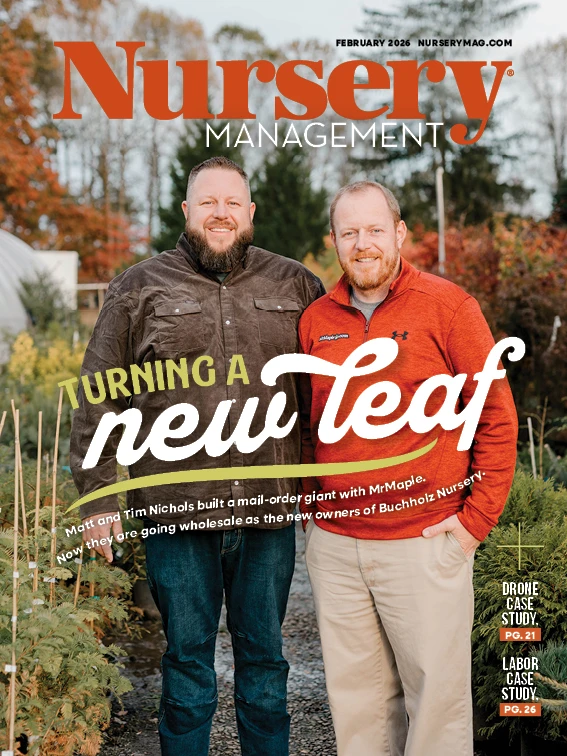
Explore the February 2026 Issue
Check out more from this issue and find your next story to read.