Editor's Note: This article originally appeared in the May 2025 print edition of Nursery Management under the headline “Sharp eye.”
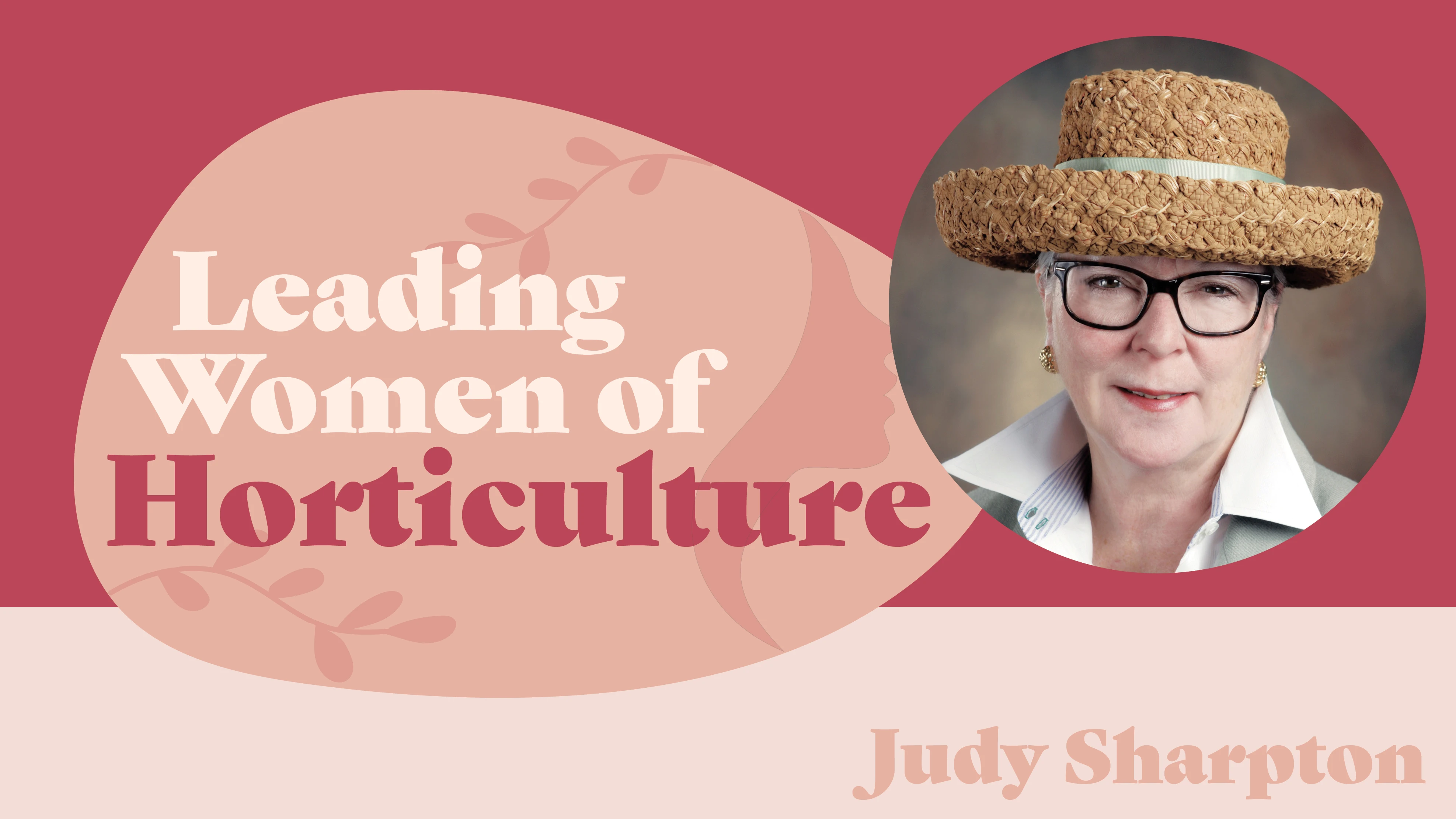
If you have ever attended a green industry trade show you may have spotted a petite woman with a Minnie Pearl type hat working her way through the crowds, with plenty of people stopping to talk to her. This is because it is Judy Sharpton of Growing Places.
Judy grew up in a small southeastern Georgia town called Screven which had two traffic lights and still has only two traffic lights. Tobacco was king back then and the community made its money growing tobacco for the cigarette industry and truck garden for food. Then in 1954 the world’s largest paper mill at that time made its way to the shores of the Altamaha River. A lot of the farmers decided to go work at “the Mill.” The pollution that spewed from the stacks at the mill was so overwhelmingly nauseous that everyone was told “that was the smell of money.”
Judy spent one day working “in tobacco” and vowed to go to college and find a job that had air conditioning. She ended up in her Uncle Hub’s grocery store that did have air conditioning but had to figure out how to get to college. The first day she enrolled at the University of Georgia was the first time she ever saw the campus. Her childhood influences were an entrepreneurial father (he grew a field of corn in his young life and sold it as moonshine in order to buy the property they lived on) and a factory-working mother with a fifth-grade education. She figured out pretty quickly and confirmed later in her life that getting an education and working for herself was superior to working for the man.
Judy’s first plants belonged to her mother; an amaryllis and a Glorioso lily in the yard and a grapevine on a pergola she could hide under when her parents had a disagreement. Early in her college career she decided she wanted to be an actress. It didn’t last past the boyfriend who wanted to be an actor then changed his major and his girlfriend.
Judy earned a degree in education, got married and had her daughter Mary Ann. Eleven was a double number for Judy because she taught public school for eleven years and was married for eleven years before “I threw my career and marriage up in the air and waited for it to fall on my head” in 1982.
After she left teaching, she took a job in the marketing department of a small publishing company and later worked at a subsidiary of Atlantic Richfield oil company until that job was downsized. Next, she became a partner in a small advertising agency, and then married the owner. When she pointed out to him that after several years of helping to build the business that she needed and deserved a promotion, he didn’t agree. Judy made the choice to create her own business and keep the marriage happy, and came up with Growing Places. Her business was the result of a conversation with a professor from the University of Georgia and a visit to the Southeastern Greenhouse Conference. After listening to a “consultant” talk about marketing is when she realized she knew everything he knew and more. When her husband finally understood that she was really going to leave the ad agency, he helped her build a professional trade show booth and helped to install it at the Southern Nursery Association trade show in Atlanta in 1994. That was the same year that Home Depot opened its first garden center and claimed it would take over the industry. She acquired two customers from that show, including a grower who wanted to launch a branded line of native azaleas called Maid in the Shade which is still on the market and being managed by the original owner’s son.
Things started happening when she published an article in the Georgia Green Industry Association magazine and got a call from the editor of the Garden Center Merchandising and Management magazine which is now GIE’s own Garden Center. After an introduction from that editor to OFA, she began speaking at the Short Course. And now she speaks everywhere.
Back to the hat, which has become a sort of trademark for her. It came from a customer that she designed a garden center for — a landscaper who refused to believe he couldn’t build a garden center over the winter in Minneapolis. That summer prior to the construction, she wore a straw gardening hat against the Minnesota summer sun. Later, when he called her to come to Minneapolis in the dead of winter to discuss plan B, he met her at the bottom of the airport escalator.
“His first words were ‘Where’s your hat?’ Judy says. “I figured if a hard-headed landscaper noticed the hat, maybe I should adopt it as my logo. It’s a great tool: if I want to be recognized I wear the hat; if I want to be incognito at the Big Bar on 2, I don’t wear the hat.”
Minnie Pearl only wore her hat when she wanted to be recognized too.
Early on, her biggest detractors were people who either thought her services were simply “fluffing” the garden center to make it pretty or who questioned her credentials because she was not a plant expert. She recalls when a well-known university professor disparaged her work (not within her hearing) at an industry event. Her polite letter to him pointed out that his words, coming from a respected member of the industry, “could damage my business to the point of negatively impacting my earning power. He was smart enough to recognize the potential legalities involved in that and issued an apology.”

Challenging the big-box mindset: Judy’s advice to IGCs
Her advice as far as the big-box stores? She has told IGC’s since 1994 “to stop wringing their hands about channels that are completely out of their control and wrap their hands around a broom to make their own stores cleaner and more appealing to a female consumer. The reality is these mass-market channels have actually contributed double to our industry: first by creating larger markets for growers (and all the support companies, including mine) and second by enlarging the consumer base for our products.”
She has helped clients find success with growth and become more profitable.
“Judy has made garden center people aware of how consumers shop,” says Ken Araujo of Araujo Farms. “Items displayed, off-the-ground flowers on benching, traffic patterns and mannequins to sell more product. Always looking to end cap displays and visuals.”
“I’ve worked closely with Judy for over 20 years and am thankful for how much she has influenced me and my career,” says Dave Konsoer, vice president of sales at Proven Winners. “More importantly, I’m thankful for how much she has helped countless garden centers in our industry. Judy has a tremendous eye for maximizing customer merchandise contact in a retail environment and has the uncanny ability to suggest to garden center owners improvement tactics that don’t require large bank loans or bulldozers. Judy is truly the best our industry has ever seen for creating impactful change within the garden center shopping environment.”
Explore the May 2025 Issue
Check out more from this issue and find your next story to read.