Adobe Firefly
The U.S. nursery crops industry has been operating in a labor deficit for decades, and the crisis is worsening due both to a limited share of available labor and increased costs to hire workers. Additionally, the Census of Horticulture (2020) recorded approximately 8,441 nursery and greenhouse operations in 2009 and only 6,458 in 2019, a 23.5% decline over 10 years. The U.S. Bureau of Labor Statistics used 2017 data for hours worked for greenhouse, nursery and floriculture production (NAICS 1114) in the U.S. as an index to compare all other years. Since its peak in 2002 at 32% higher than in 2017, the total number of wage and salary workers within business establishments declined approximately 50% in 2024 from that 2002 high (2002:132%; 2017:100%; 2024:82%).
Nursery Management (2024) reported that approximately 65% of survey respondents did not hire new workers. Limiting factors included increased wages (26%), insufficient availability of qualified labor (32%), financial limitations (28%) and added automation systems/processes (9%). Respondents did not specify whether automation limited new hires because it reduced labor needs, or it allowed operators to allocate existing labor more efficiently, reducing the need for new workers.
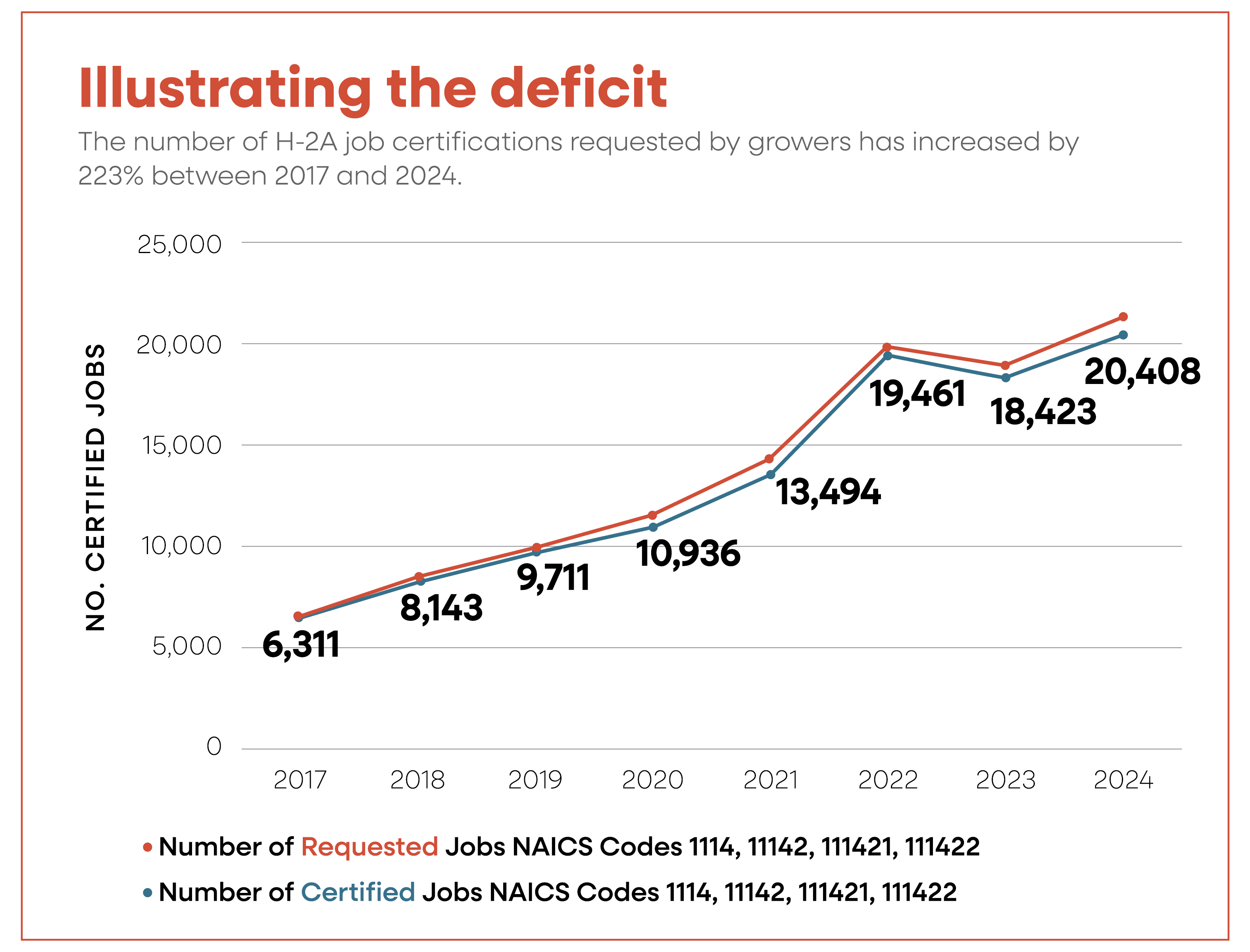
Lack of available labor will not be remediated by U.S. births anytime soon. The birth rate in the U.S. has been at or below the replacement level of 2.1 births per woman since 1970, and declined to 1.75 since the 2008 Great Recession. The Prime Employment to Population Ratio (EPOP) measures the percentage of the working-age population that has a job. For ages 25 to 54, it’s 81%. This is consistent with previous levels dating back to 1990, but much higher than from 1950 (62%) to 1980 (75%) (FRED 2025). Though record levels of current available workers are working, nurseries still experience shortages. To supplement this lack of labor, nursery growers have been utilizing H-2A labor. The U.S. Department of Labor disclosure data (U.S. Department of Labor 2025) suggests that the number of H-2A job certifications requested by businesses that self-identified with North American Industry System Classification codes (NAICS) 1114, 11142, 111421 and 111422 (i.e., greenhouse, nursery, tree and floriculture production) has increased by 223% between federal fiscal years (FYs) 2017 and 2024, going from 6,311 job certifications in FY 2017 to 20,408 job certifications in FY 2024. Nursery operators using the program indicate that this visa program is a reliable source of labor; however, there are challenges related to the use of the program, such as cost, the seasonal aspect (difficult to address year-round labor needs) and regular changes in the rules and regulations governing the program that increase the risk of using this program for employers (Velandia et al. 2023).
Nursery producers have to rely on U.S. labor availability markets to meet consumer demands and remain sustainable in the future. Soil is strictly controlled under APHIS quarantine regulations 7 CFR 330 because it provides a pathway for the introduction of a variety of dangerous organisms into the U.S. Therefore, the green industry cannot grow plants in countries with low cost, available labor, then ship plants to the U.S. Conversely, this prevents other countries from importing field or container grown plants and saturating U.S. markets. To remain sustainable, producers need to rely less on labor.
Future strategies
Automation is one way to both fill the void left by workers who are not applying and retain current workers by making their jobs less physically demanding. New nursery-specific automations are being designed, developed and tested with funding from private stakeholders, state and federal funds and trade commodity organizations. This work is supported by the Specialty Crops Research Initiative Coordinated Agriculture Project Award no. 2024-51181-43291 (awarded $9.8M) from USDA NIFA, which aims to develop four new pieces of nursery automation technologies and increase adoption of commercially available mechanization and automation, as well as investigate economic feasibility, adoption patterns and consumer willingness-to-pay for worker friendly nursery automation. LEAP Forward: Innovations in Nursery Automation over the next 12 months will highlight some strategies growers can take to reduce labor and remain sustainable. Visit www.nurseryleap.com in the meantime to learn about strategies others have used to address these same challenges.
Acknowledgments Labor, Efficiency, Automation, Production: LEAP Nursery Crops Toward Sustainability is supported by the Specialty Crops Research Initiative, Coordinated Agriculture Project, award no. 2024-51181-43291, from the U.S. Dept. of Agriculture’s National Institute of Food and Agriculture. Any opinions, findings, conclusions, or recommendations expressed in this publication are those of the author(s) and should not be construed to represent any official USDA or U.S. Government determination or policy.
Explore the January 2026 Issue
Check out more from this issue and find your next story to read.
Latest from Nursery Management
- Jackson & Perkins expands into Canadian market
- Green & Growin’ 26 brings together North Carolina’s green industry for education, connection and growth
- Marion Ag Service announces return of Doug Grott as chief operating officer
- The Garden Conservancy hosting Open Days 2026
- Registration open for 2026 Perennial Plant Association National Symposium
- Artificial intelligence applications and challenges
- Fred C. Gloeckner Foundation Research Fund calls for 2026 research proposals
- Harrell’s expands horticulture team with addition of Chad Keel