Photos by Katie McDaniel
Editor's Note: This article originally appeared in the February 2026 print edition of Nursery Management under the headline “International Plant Trialing Conference.”
After a 10-year hiatus, the International Plant Trialing Conference returned in October 2025. About 160 industry professionals gathered in Minneapolis, Minnesota, to talk about one thing that they all had in common — trialing.
“Trialing is important to our industry,” says Melinda Knuth, assistant professor of horticultural science at North Carolina State University. “It’s foundational. It’s critical. It’s an extremely valuable activity for all of us in the room. You’ve got to know how plants perform, and you have to have acceptable measurements in order to make good decisions.”
The conference was hosted by All-America Selections (AAS), a program managed by National Garden Bureau (NGB). AAS is an independent non-profit organization that tests new, never-before-sold varieties for the consumer.
“We’re excited to continue the education and the forward thinking that’s going to keep us evolving,” says Chelsey Lenczyk of Bejo Seeds, NGB vice president of AAS trials program committee. “If you know AAS, then you know that ‘tested nationally; proven locally’ is what we’re all about. We’re all looking at these genetics that come from all over the world — genetics which are the heart of our industry — which keep us all moving forward and bringing new plants and new interesting things out to the public. … We’re responsible for that, and that’s a big task and a really big honor.”
The event was filled with local tours and two days of educational sessions covering a wide range of topics, including ornamentals, edibles, plant trialing techniques and industry trends.


More trials = less surprises
In the session, “Value of Trials,” panelists Alicain Carlson from Syngenta Flowers, Pat Hoehn from Bonnie Plants, Chelsey Lenczyk from Bejo Seeds, Chad Miller from Colorado State University, David Roberts from Bailey Nursery and Scott Rusch from Express Seed Company discussed the critical role of trials. They explained that one way of measuring the value of doing trials is through data collection.
Research and development and plant trialing has a lot of data collection, and a significant amount of the job itself is collecting the data.
Some of the new data collecting software and systems allow trial managers to go out in the field, take pictures of the plants with their cell phone and automatically upload the photos to the system through an app.
“Often when you’re in the field, you don’t have internet access in order to upload the photos, but some of the new systems will upload the photos once you get back within service range,” says Heather Gronek, operations and R&D manager of Plant Development Services, Inc.
Gronek shares that having a system in place where you can collect it and not spend hours trying to catalog data is very important because a large part of plant trialing is collecting data and communicating the results.

“No matter what opinion one person might have about a plant, if the data shows that this is something we’re looking for and can have confidence in, it can help in those conversation or debates,” says Roberts. “So, I think the value of that data is helping us be confident to move forward with an introduction, understanding that this is the product we’re looking for at the time.”
Rusch shares that one of the reasons people in the industry need confidence and need the data, is because plants are inherently a risky business.
“If you sell a plant to a consumer that doesn’t grow well, guess what? They’re not going to buy that plant again, or even worse, maybe they don’t garden again,” he says. “The better job we do at trialing and getting the right plants for the end user, the stronger and healthier our market will be long-term.”
Because of the trialing process, breeders, plant developers, young plant producers, growers and retailers can have confidence in those plants being the right plants for the end user — which eliminates some of the risk.
“If we can take those risk points out for our end consumers by using the data, using the confidence that we have, it will pay dividends in the end by expanding the market,” Rusch says.
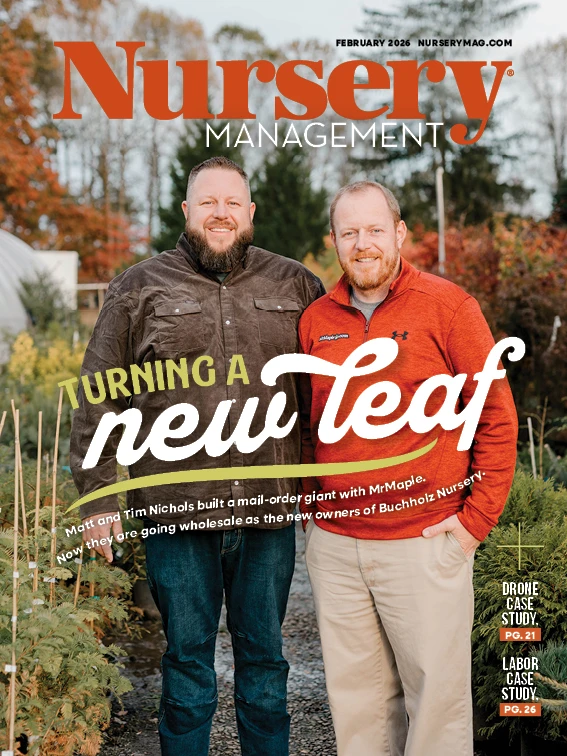
Explore the February 2026 Issue
Check out more from this issue and find your next story to read.