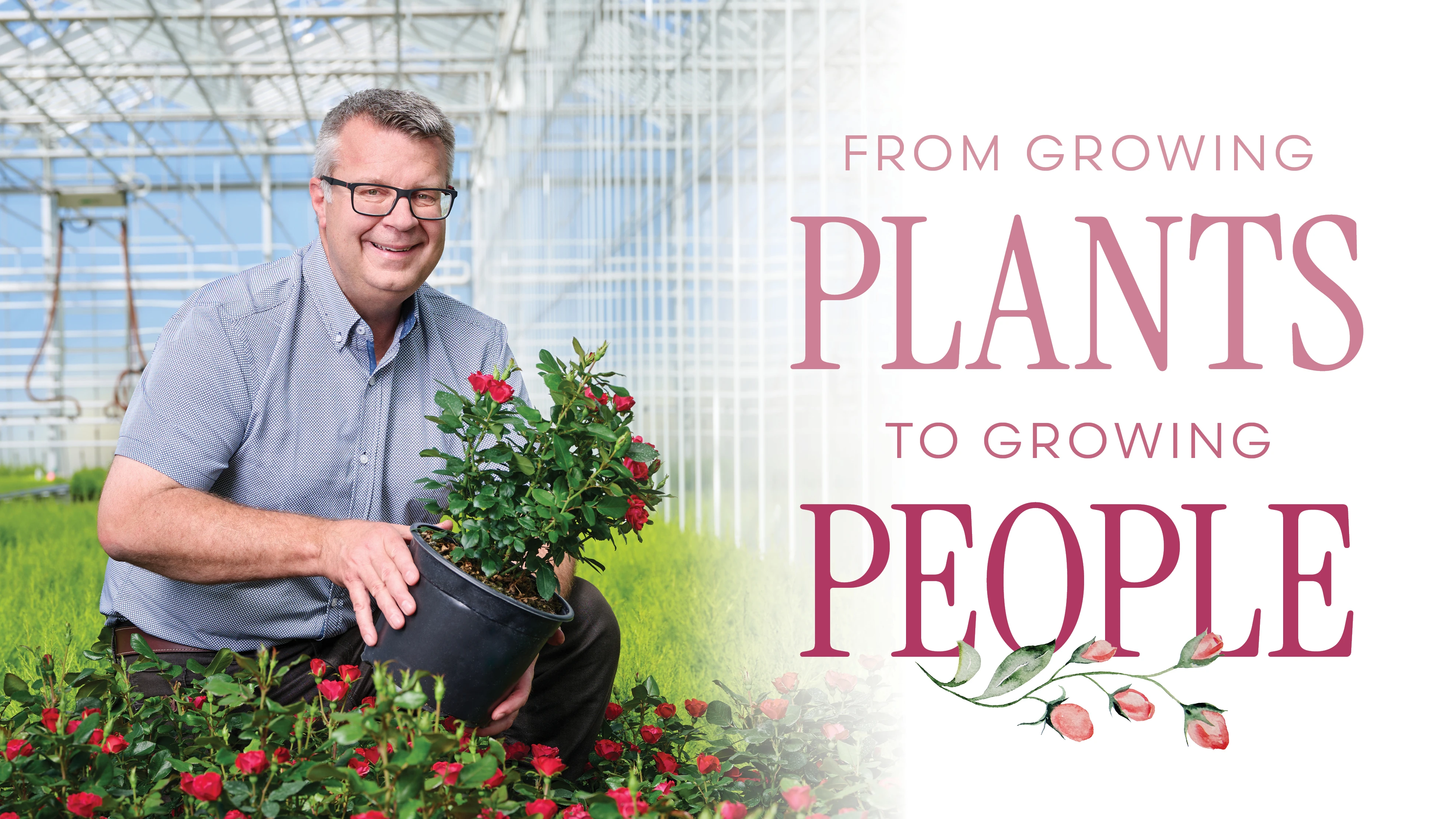
Photos by Erich Saide
Editor's Note: This article originally appeared in the November 2025 print edition of Nursery Management under the headline “From growing plants to growing people.”
Deep, honest expression without concern for the anticipated response. Gary Neels understood he had to develop that skill if he wanted to become an effective CEO for his company, Qualitree. But as he spoke about the person who inspired him most to 15 fellow students in a Dale Carnegie leadership class, the response he did not anticipate was his own.
“I just completely fell apart. I stood there for two minutes straight. I just … Was frozen,” Neels says.
He wasn’t frozen from fear. He’d fallen apart because he was speaking about his oldest son, Corey, who had been battling leukemia for years after being diagnosed at 17 years old. Neels wanted to explain how his son’s struggle was inspiring. He wanted to express how he considered his oldest child his hero for enduring treatment after treatment. But the words wouldn’t come. Only the emotion.
“The coach brought me back on track,” he remembers. “And I was able to have a conversation about that whole experience with two junior employees who were 25 to 30 years younger than me, looking at me. And I felt like a little elementary school kid going through this process.”
That talk in an intimate leadership workshop was an intense experience for Neels, but it was also a surprising experience. After all he thought he’d be able to handle himself and go deep.
Once the workshop ended, he was curious how the junior Qualitree employees had perceived his talk. Here he was, a founder, owner and the CEO of Qualitree breaking down in front of subordinates. Had it changed the way they thought of him?
“I pulled them aside separately and I said, ‘So I fell apart there. I know I did. How do you feel about that?’” Neels remembers. “And the response was interesting. They said, ‘We gained a lot of respect for you through that process. First of all, you’re genuine. You were able to do it, and now we feel, suddenly that, okay, we can be human too. Because you’re just like us, whether you’re a CEO or not.’”

Lessons like that are what have honed Neels’ leadership as the CEO of his Canadian-based 100-acre wholesale propagation and growing company. But at 50 years old, there are plenty more lessons to learn. He’s been learning them since starting the business at 19 years old with partner Tony Van Oort. He has no intention of stopping now.
Planting the seeds of Qualitree
Neels is the son of parents who each separately immigrated from the Netherlands to Canada when they were kids. He grew up in what he describes as a “conservative, reformed” community. And as part of that community, he attended private school until he graduated in 1992.
After graduation, Neels admits that he was looking for some kind of direction. He’d always been interested in horticulture and remembers being a kid and helping his grandfather plant vegetables — learning how to use a hoe and “old style weeding machines.” During his high school years, he’d been working with a landscape installation and maintenance business and had planned to join full time after graduation, but the opportunity dried up.
Then he met Tony Van Oort.
Van Oort had gone to the same school but had been in a different class, so while the two Canadian Dutch kids had known each other for years, they weren’t necessarily close. But one day a simple conversation changed their trajectory.
“I happened to bump into Gary,” Van Oort recalls. “And he asked me what I was doing and I said, ‘Well, I’m taking the horticulture program at the University of the Fraser Valley.’ And he’s like, ‘Oh, I’d really be interested in that, tell me more.’”
Neels joined the program and as the two attended classes, they became friends. Van Oort says it was a good match considering they were both incredibly shy. The shared history helped and gave each an ally. When a project came up to start an end-to-end business on paper, it was natural that the pair would partner up.
Both of their fathers were taking a chance on growing hedging cedars, which was a risky bet that had paid off as British Columbia began seeing a shortage in the 90s. But the men were struggling finding supply of young plants that weren’t wildly expensive, thanks to few suppliers and large demand. So, Neels and Van Oort created a theoretical propagation business that would be able to supply those plants.
About two months after graduating from the university, Neels called Van Oort suggesting they make their paper business a reality. After all, the project required they submit a financial plan, a sales plan and a budget. Also, Neels had found a used greenhouse for $2,000 in the classifieds and his father had offered the backyard for the initial location of the nascent business.
Van Oort was in. Soon enough, the teens were digging a 4-foot-deep trench by hand to accommodate a water line for the greenhouse and considering business names. Qualitree was born.
Neels and Van Oort point out that their first crop of young ‘Emerald Green’ arborvitae was wildly successful. They propagated 72-cell trays, about 100,000 plants, and achieved a 98% success rate. That first season was point of pride for the duo who were able to not only supply their fathers’ needs but consider sales to new customers.
“We were the world’s best, is how we felt,” Van Oort says. “And the next year we decided we need to get more production. And we heard about this concept called open trays, where you could just have open trays and put a lot more cuttings in. So instead of 100,000 cuttings, we did 200,000 cuttings in open trays.”
But horticulture has a way of keeping growers humble. And the young men learned an important lesson in humility.
“Lo and behold, we had an entire crop failure,” Neels says. “I mean, we were basically in tears. We can’t supply our parents, first of all, and then all the new customers that we were going to let down. So we shared it with family members, and we had a whole group of volunteer laborers, and we redid the entire production and we had a beautiful result.”
Van Oort notes it wasn’t just family helping with the rescue, it was also friends and girlfriends and neighbors. The whole community seemed to come to their aid.

The ‘Emerald Green’ rescue was a defining moment in the culture of Qualitree. The two young founders were struck by the realization that not only do they always need to be accountable, no matter what, but none of the work gets done without people who care, helping one another along the way. And as Qualitree expanded to its current size, those ideas remained enshrined in three of the company’s core values: “A promise made is a promise kept,” “Our jobs are important. Our families are more important,” and “If you want to go fast, go alone. If you want to go far, go together.”
Growing a leader
Neels was comfortable as a grower and a founder. He even stretched himself by taking trips back to the Netherlands to make connections with growers there to share knowledge. (It helps that he is fluent in Dutch).
“We have lots of direct connection with very good growers who are very willing to work with us,” Neels says. “And we speak of remuneration, but for them, it’s almost like passing on the heritage. It’s like they don’t mind. We’re not competing because we’re not selling in their marketplace. They enjoy interacting. And interestingly enough, they learn from us and our mistakes and sometimes implement some things that help them.”
But while he was leading a team in the greenhouse and leading connections to overseas partnerships, his training as a leader had always been largely informal. Though he did have a mentor in Henk Rozendaal who joined Qualitree as a partner in 1999 (before Neels’ first trip to Europe) to head sales and marketing. Rozendaal was 20 years older and far more experienced.
“I learned an awful lot by observation and asking questions and challenging and asking them to give feedback on myself,” Neels says.
He credits Rozendaal with helping him understand that leadership is never about the leader, but about the people around the leader who need to be developed, just as they help the business develop.
And as Qualitree continued to grow one of the major challenges came when they understood the business needed an ERP system to help them track production. The problem was that all of the ERP systems they encountered were made for manufacturing. But growing plants isn’t like making a widget so the system they eventually tried was completely inadequate for their purpose.
That’s when Van Oort and Neels realized that Qualitree could use its own money, infrastructure and time to build a proprietary ERP software system for the horticulture market that would help solve an industry blind-spot. They partnered with a technology company out of Holland and committed to 5 years of testing and building before going to market.
“I think Gary displayed his character during this time because he wasn’t CEO yet. He was head grower. The ERP really wasn’t helping him,” Van Oort says. “But when you decide to do something together, you do it no matter what happens, no matter how tough it gets, and believe me, it got tough.”
Over the five-year development period the software project began to take up more and more money. Van Oort admits that it was a drain on the company’s finances for years, but says Gary never flinched, even if Qualitree’s leadership team questioned the move.
Eventually Qualitree became the pilot for the software two years into development. But there were three years left until launch, which meant more money going into the project.
“But Gary just stands by,” Van Oort says. “it’s like that’s the decision we made. We made it together and we stood by it. “Because when you quit, then something beautiful doesn’t happen.”
Once the five years had elapsed, the horticulture focused ERP system IQ Grower was launched in 2023 and Aster Software group was created after being incubated inside of Qualitree. But the new sister company needed leadership. And that leadership had to come from the Qualitree team. Van Oort left to join Aster, as did Qualitree’s CEO at the time Gerrit Rozendaal (son of Henk).


That left a vacuum at Qualitree that needed to be filled and the team looked to Neels as the leader in waiting and asked: Will you be the CEO?
The reluctant CEO
Most people may have a sense that CEOs are born to the role. They come into the world with the kind of qualities that make them natural leaders. Neels says he believed that too. And frankly, he didn’t think he had the necessary qualities despite working with a leadership mentor group for about a year before being asked to lead the company he founded. Still, he accepted the role.
“Before that, I led a department, I led the growing piece of it, and I had been working and developing a team,” Neels says. “I was part of the management team, one of the owners. Then I was appointed to this role, and I suddenly realized that I couldn’t look around anymore and wait for some leadership to happen.”
But Neels stepped up. He began asking a lot of questions. He asked people to hold a mirror up to him as well, so he could understand himself better. And like that lost crop back at the start, he was humbled.
“I’d ask how I was doing and the response was, ‘You’re doing excellent here, here and here. And here I think you need to do something different,’” Neels says. “And I didn’t see it in myself until they showed me. I learned I need to ask those questions much more. It has been super helpful for everyone, because when I got vulnerable and allowed these conversations to happen, it created an opening so others could do the same.”
That vulnerability and openness is rooted in Neels’ Christian faith which guides both his business and his family and community. It is at the core of the company’s values. He notes that the goal isn’t to push that faith upon people but to live the faith and lead as an example to others.
“We believe in the golden rule: Do unto others as you want them to do unto you. And we stick to that firmly,” Neels says. “When I become CEO, we did a values survey. For instance, we asked about one of our core values: We do what we say. There was interesting feedback. At times it appeared we didn’t do what we said. So we had some good conversation around that. We need to bring this back to what our core values are. We do what we say internal and external and personally.”

And it seems Neels lives those values.
“What most inspires me about Gary, through the many qualities I admire, is his kind resilience,” explains Qualitree Production Technical Lead Stephanie Saccomano. “I’ve never met another human who can maintain a firm stance while also offering highest respects to his peers.”
That resilience has been particularly important recently. In September of 2024 Corey Neels passed after his long fight with leukemia, leaving behind a wife and child. And a grieving father.
“In the face of a heartbreaking loss as a father,” Saccomano says. “He has continued his leadership efforts while demonstrating that vulnerability is not only okay, but a strength worth sharing.”
Neels isn’t afraid to talk about his loss and the grief. “It’s built a lot of resilience and strength for myself, our family, and I believe the business too,” he says. “Because this has taught me that we’ve had similar experiences in our business life with other people going through similar things. And I didn’t understand until I really experienced something deep like that myself. Now I can understand much better and also support these individuals in a better way.”
The reluctant CEO through loss and vulnerability and a firm stance on his faith, is no longer reluctant. While he is still asking questions, he is thankful for the opportunity to be a leader. Ask him what he is most proud of and the answer is fairly simple.
“The moment I’m proudest of, and there’s many, is when I see the team develop as individuals and I recognize my influence in it. They developed, I helped them through influencing them,” he says. “We say we grow plants, but I like to think I used to grow plants. Now I’m growing people.”
Watch a video of the GIE Media Horticulture Group recognizing Gary during Cultivate'25 here.
Patrick Alan Coleman is editor of GIE Media's Greenhouse Management magazine. Contact him at pcoleman@gie.net.
Explore the November 2025 Issue
Check out more from this issue and find your next story to read.