Editor's Note: This article originally appeared in the March 2026 print edition of Nursery Management under the headline “Efficiency vs. efficacy.”
An effective weed control program is a combination of a good herbicide rotation along with sound sanitation and cultural practices. Simple, but not easy. Chemical costs can be high while things like weather, labor availability and other production tasks can delay applications and allow weeds to take over. In many cases, nurseries can significantly reduce costs and improve control simply by changing the equipment that is used to apply preemergence herbicides, or by potentially changing the herbicide formulation being used. If you are looking to reduce chemical costs, improve application timing or simply make your herbicide applications more efficient, there are several different factors to consider, which might improve your results.

Comparison of granular vs. spray-applied formulations
One way many growers are opting to save money is by switching from a primarily granular-based herbicide rotation to using more spray-applied herbicides. There are advantages and disadvantages for types of formulations. For granulars, you have more herbicide options (i.e. active ingredients), usually lower equipment costs and often better crop safety, but the chemical and labor cost is higher. Granulars cannot be applied to wet foliage, which can narrow application windows. For liquids, you have fewer herbicide options, but the chemical and labor costs are lower.
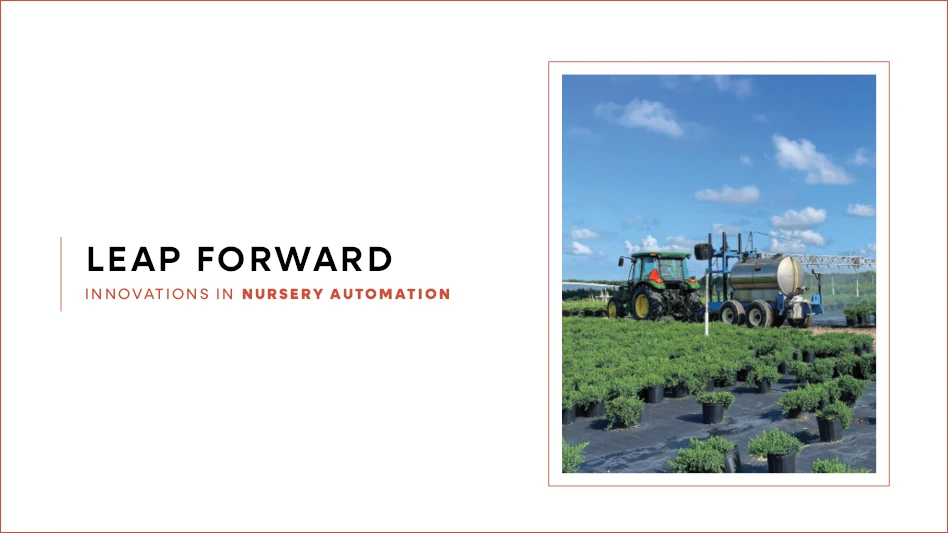
The L.E.A.P. nursery research team is currently evaluating different types of herbicide application equipment from both an efficiency and an efficacy standpoint. Preliminary data is showing that on average, growers can typically cover about 8 to 10 times the area with large boom type sprayers (Figure 1) compared with standard hand-crank or “belly-grinder” type spreaders. Further, growers are reducing chemical costs by over 50% by switching to more spray-applied herbicides. Currently, the use of drones is somewhat changing the game when it comes to granular applications and is also being evaluated as part of our L.E.A.P. research. Although this technology is still in its infancy compared to other types of equipment, data suggests that an acre can be treated with a drone in less than 10 minutes with a high degree of accuracy. The use of drones is likely to increase substantially in the coming years as more people are trained in their operation and more equipment options become available.

Efficiency vs. efficacy
For spray-applied herbicides, most labels allow for applications to be made with spray volumes of 20 to up to 200 gallons per acre (gpa). It is much more efficient to apply lower application volumes as more ground can be covered with one spray tank. However, for preemergence herbicides to be effective, they need to reach the soil surface, sometimes through dense plant canopies. For many of the growers we have worked with, they reported significantly better weed control when they increased their spray volumes up to 50 to 100 gpa or more, as they achieved better canopy penetration (Figure 2).
While granular herbicides are going to be applied at the same rate regardless of the equipment being used, different types of application equipment can affect how efficiently and accurately they are applied. For example, belly-grinder spreaders can cover fairly large areas quickly, but much of the applied herbicide (60% or more depending on pot spacing) lands outside of the container. While it provides a weed control benefit, it can be viewed as being wasted, especially if the plants are on a weed mat in good condition. In contrast, gravity flow type spreaders (Figure 3) require more labor hours, but less herbicide is typically needed, as the applications are more targeted.

Developing solutions for every nursery
Each nursery will have diverse taxa and production needs, different infrastructure, labor needs and other unique challenges which precludes the use of one-size-fits-all solutions. The L.E.A.P. research team is currently evaluating many different types of herbicide application equipment to determine which options are the best fit for different types of operations. Data is being gathered on hose-and-reel type sprayers, gas-powered granular spreaders and homemade shaker jars, as well as advanced AirTec spray systems.
Effective rotations can be built with either granular or liquids, and many different types of equipment can be used or adopted to achieve significant savings. The best option is going to depend on nurseries’ unique needs.

Explore the March 2026 Issue
Check out more from this issue and find your next story to read.