PHOTOS: MARK DWYER
Editor's Note: This article originally appeared in the June 2025 print edition of Nursery Management under the headline “Coreopsis tripteris ‘Lightning Flash’.”
While gardeners understandably appreciate their flowers, the nuances of foliage color and texture can also be primary contributors for visual appeal. This is certainly the case with the ‘Lightning Flash’ tall tickseed (Coreopsis tripteris). I was fortunate to grow and observe a cluster of three of these plants in full sun over a 10-year period and was always attracted to the bright gold foliage which caught attention from a great distance and offered foliage appeal over the entire growing season. Found as a seedling at the former Messenbrink’s Nursery in North Carolina, ‘Lightning Flash’ was first introduced in 2007, and while I don’t see it offered widely (enough), it is a worthy candidate for the garden with the stellar combination of glowing foliage and showy summer flowers.
Reaching 3 to 5 feet when in bloom, this upright, clumping perennial thrives in heat and humidity. The North American native species is very soil adaptable to include poorer soils. However, adequate drainage is paramount, and this species is drought tolerant once established. Planting this selection in full sun is ideal, although in hotter climates, some dappled afternoon shade will help protect the foliage during the hottest portions of summer. From spring emergence, the lance-shaped, bright gold foliage is striking and quite dense from ground level. These narrow, quinquefoliate leaves may transition to chartreuse in summer (or in less sunlight) but still offer a visual “punch.” The foliage is both rabbit and deer resistant. This selection is also considered tolerant of urban pollution.
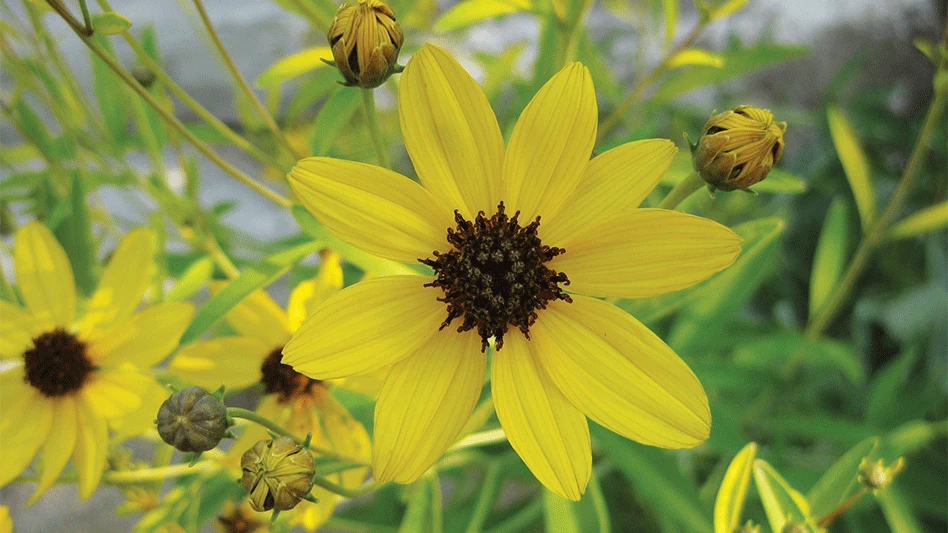
The golden-yellow flowers emerge on erect stems in terminal clusters in mid-summer (lasting 5-6 weeks) and feature red-brown centers. One of the few criticisms of ‘Lightning Flash’ is that the flowering volume is variable from year to year. While I always saw my specimens bloom, some years were admittedly more “robust” than others. Bees and butterflies will find these plants in bloom. In the Mt. Cuba Center (Hockessin, Delaware) trials, there was some disappointment with this variety due to leaf spot infections and the variable flowering. However, they did praise the significant ornamental value of the golden foliage. Crown rot is not uncommon in poorly drained soils.


Explore the June 2025 Issue
Check out more from this issue and find your next story to read.