To extend the specialty cut-flower season, growers may need to germinate seedlings indoors, such as in basements, offices or other small spaces. To support this practice, growers commonly use affordable consumer-grade light-emitting diode (LED) fixtures purchased from hardware stores or online. However, these fixtures typically lack clear instructions for critical aspects — including the number of fixtures required, optimal fixture spacing and appropriate mounting distances — to achieve a uniform light intensity.
Providing an adequate and uniform photosynthetic light environment is essential for promoting seedling quality, vigor and uniformity, thereby ensuring success in the field, high tunnel or greenhouse. Previous research by Kohler and Lopez (2021) at Michigan State University demonstrated that a photosynthetic daily light integral (cumulative amount of light a plant receives over a day) of 10 to 12 mol·m–2·d–1 is necessary to reduce young plant production time and increase stem strength and roots while improving seedling growth and uniformity. Indoors, this DLI can be achieved by delivering a light intensity of 175 to 200 µmol·m–2·s–1 for 16 hours per day, resulting in a DLI of 10.7 to 12.2 mol·m–2·d–1.
Even with these guidelines, small growers often lack specialized and often expensive equipment (e.g., quantum sensors) needed to implement the target DLI using inexpensive LED fixtures properly. Therefore, this study was designed to determine the required quantity and mounting distance of consumer-grade LED fixtures to provide a uniform light intensity of 200 µmol·m–2·s–1 on a utility shelf for specialty cut-flower seedling production. Additionally, we sought to quantify the effects of different light qualities (wavelengths or colors) from the various consumer LED fixtures on seedling growth, development and quality.
Consumer LEDs for specialty cut-flower production study
Seeds of sunflower (Helianthus annuus) ‘ProCut Lemon’, snapdragon (Antirrhinum majus) ‘Potomac Yellow’, stock (Matthiola incana) ‘Katz Purple’ and dianthus (Dianthus barbatus) ‘Sweet Black Cherry’ were sown in 128-cell trays in a 50:50 (v/v) commercial soilless medium composed of 86% peat moss and 14% perlite to 50% coarse perlite. The trays were placed on utility shelves (4-tier steel wire shelving unit in chrome, 36 inches wide by 54 inches high by 14 inches deep) wrapped with panda plastic (white on the interior and black on the exterior) to increase light reflectivity, uniformity and heat retention (Figure 1). The shelves were placed in a basement room without windows and a temperature set point of 65 °F. Small exhaust fans (Beyond Breeze 9-inch box fan, model number BF9) were added to encourage airflow and uniform temperatures across the top and bottom shelves, resulting in an average daily temperature of 71.8 °F. After adjustments and spacing, the following 4-foot consumer LED fixtures provided an average photosynthetic light intensity of 211 µmol·m–2·s–1 16 hours per day:
Consumer LED fixtures
- Barrina LED Shop Light (40-watt), Daylight White ($79.99 for six bars)
- Barrina Plant Grow Light Strips (42-watt), Full Spectrum ($52.99 for three bars)
- Kihung LED Grow Light Strips (42-watt), Full Spectrum ($129.99 for eight bars)
- Monios-L T8 LED Plant Grow Light Strips with Reflectors (84-watt), Full Spectrum ($48.99 for two bars)
- Monios-L T5 Plant Grow Lights (20-watt), Red and Blue ($78.99 for six bars)
- SHOPLED Grow Light (40-watt), Full Spectrum ($79.99 for six bars)
Twenty eight days after sowing, 10 seedlings of each species were harvested, and data were collected on stem length, caliper, root dry mass and shoot dry mass. These measurements were then used to calculate the total dry mass (TDM), root to shoot ratio (R:S), sturdiness quotient (SQ; stem length/stem caliper) and quality index [TDM × (R:S + SQ)]. At harvest, photographs were taken to document the effects of the treatments.


Results
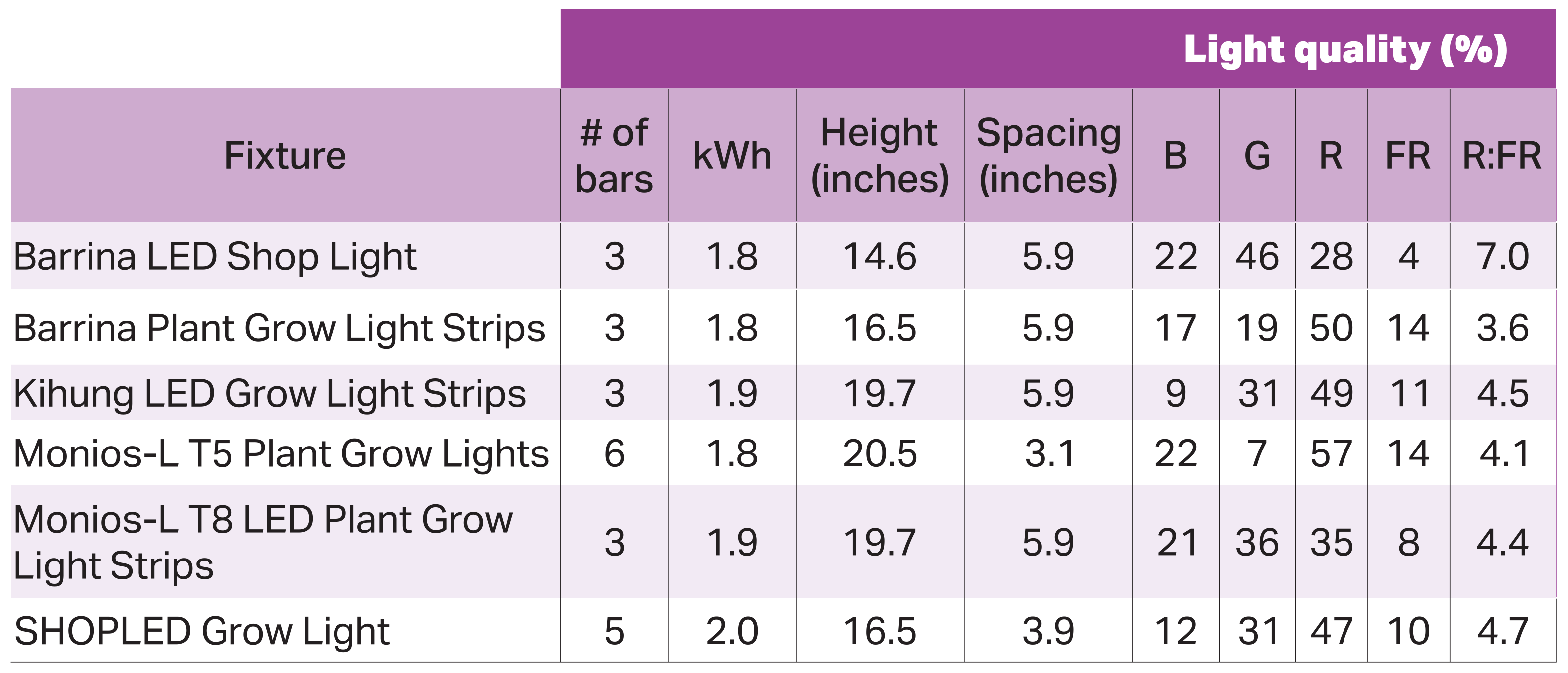
Overall, we noticed similar seedling performance across the light fixtures. Only the quality index of dianthus and snapdragon (Figure 3) seedlings was affected by the light fixtures, whereas the quality index of the stock (Figure 2) and sunflower (Figure 4) seedlings was comparable across fixtures. Table 1 shows the number of bars used, energy use in kilowatt-hours over a 16-hour photoperiod, the fixture height from the seedling trays and spacing between fixtures necessary to achieve the target light intensity of ~200 µmol·m–2·s–1 and the percentage of blue, green, red and far-red light emitted by the fixtures.
The stem lengths of all species were impacted by the LED fixtures, with seedlings under the Kihung fixture generally being the tallest. The increased stem length observed under the Kihung fixture is likely due to the low blue-light fraction and a moderate red-to-far-red ratio (R:FR). Both high blue-light concentrations and R:FR ratios can reduce stem elongation, producing more compact plants. For the Kihung fixture, blue light accounted for only 9% of the total light delivered, and the R:FR was 4.5; neither was sufficient to promote compactness. Understanding the effects of blue light and R:FR also explains why seedlings under the Barrina LED Shop Light fixture were generally the most compact, as it delivered the highest concentration of blue light and the highest R:FR. Stem caliper, or the thickness of the seedling stems, was also impacted by the fixtures in all species except for sunflower. However, the overall stem caliper impact was relatively mild and was species-dependent on which fixture produced the thickest or thinnest stems.
Shoot and root dry mass are indicators of how light influences photosynthesis and ultimately total biomass production, and both are indicative of seedling quality. Dry mass was significantly affected by the LED fixtures in the stock and snapdragon seedlings, whereas the dianthus and sunflowers were comparable across fixtures. For stock, the SHOPLED Grow Light produced a slightly greater shoot and root dry mass than the rest. Similarly, snapdragon shoot and root dry mass were lowest under the Barrina Plant Grow Light Strips and greatest under the Kihung and SHOPLED Grow Light.
The quality index of stock and sunflower — accounting for total dry mass, crop sturdiness and the root-to-shoot ratio — was not influenced by the fixtures. Dianthus performed better under the Barrina LED Shop Light than under either Monios-L fixture, whereas the remaining fixtures produced comparable-quality seedlings. For snapdragon, we saw the greatest quality index under the Kihung and SHOPLED Grow Light.

Conclusion
Overall, all light fixtures produced seedlings of suitable quality. If you are using any of these tested fixtures, we recommend following the height and spacing utilized in Table 1 to ensure the light intensity is in the 200 µmol·m–2·s–1 range over a 16-hour photoperiod to achieve a DLI near 12 mol·m–2·d–1.
Latest from Nursery Management
- [SNEAK PEEK] Leading Women of Horticulture: Angela Burke
- Get to know Hailey Clark
- Get to know Brian Kemble
- Proven Winners partners with Pure Line Seeds to offer vegetable plants
- Award winners announced for 2026 PHS Philadelphia Flower Show
- Kansas City botanical garden Powell Gardens acquires IGC Colonial Gardens
- [SNEAK PEEK] Leading Women of Horticulture: Delilah Onofrey and Krystal Snyder
- [SNEAK PEEK] Leading Women of Horticulture: Alexa Patti