Editor's Note: This article originally appeared in the August 2025 print edition of Nursery Management under the headline “Acer truncatum: Shantung, Shandong or purpleblow maple and hybrids.”
Acer truncatum is certainly not a household word. It may be uncommon in the arboricultural, nursery and landscape industries, but it deserves greater use. Small trees, 20 to 30 feet high and wide, with Zone 3 to 9 adaptability, are rare, and this checks all those boxes, plus wide soil tolerances.
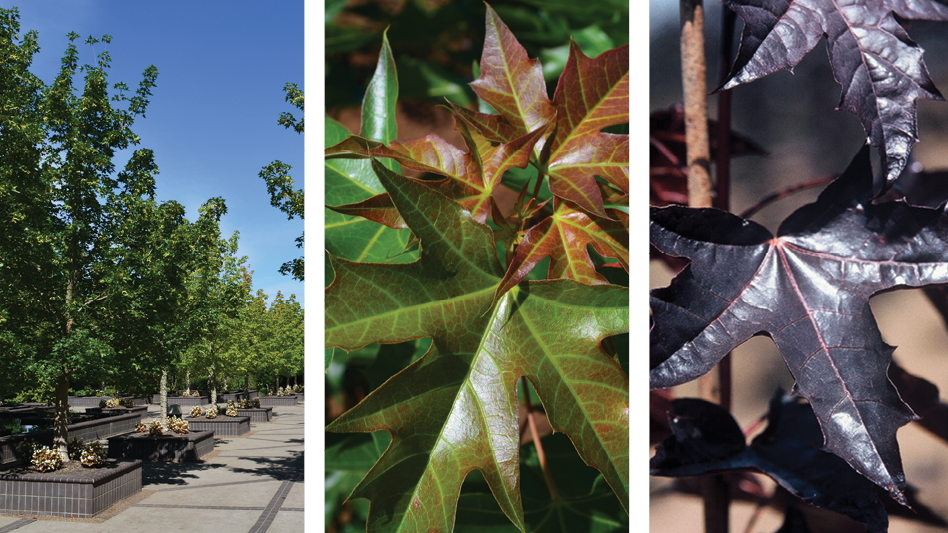
Michael Hayman, TreesLouisville (www.treeslouisville.org; expanding Louisville tree canopy), and I frequently share information on tree species that embody worthy ornamental traits and urban tolerances. Our most recent discussion focused on A. truncatum, an underutilized Chinese/Korean species (also Russia, Japan and Manchuria listed). Hayman is sourcing (testing) species and cultivars that prosper in the heavy, high pH, unamended soils of the Louisville area. He is frugal and careful with the non-profits’ resources, so he endeavors to be sure whatever is planted will survive/thrive. The species grows in many Chinese provinces (I counted 11) and the Korean Peninsula to 3,300 feet (Flora of China). The Morris, Arnold and U.S. National Arboretum hold wild collected specimens from China and Korea. The late John Pair, Kansas State University, championed the species for the plains and southwestern states. With such a wide native distribution, hardiness and other traits vary significantly, the most prominent examples being the emerging green to bronze-purple foliage and the yellow (pure), orange, to brilliant red fall colors.
Hayman reported that every 20 years, fully foliated Acer palmatum (first week in April, Louisville) are killed outright and/or severely injured by late freezes. Buddy Hubbuch, a horticulturist at Bernheim Arboretum in Clermont, Kentucky, lost all Japanese maples but ‘Bloodgood.’ Further, the great Don Shadow of Winchester, Tennessee, lost 50 A. palmatum cultivars except one from Hillier’s. Hayman is growing the Hillier clone in Louisville where it is prospering. The merits of A. truncatum include small tree size like A. palmatum, superior cold, heat, drought and pH tolerances, frost/freeze resistant, young and mature leaves and the potential for superb fall color with selected cultivars.

Size and tolerance
Let’s dissect and discuss the species and the superior cultivars’ characteristics. A. truncatum forms an upright-rounded to rounded crown with strong branches, the foliage forming a dense canopy. Landscape sizes average 20 to 30 feet high and wide. The U.S. National Arboretum has a wild collected, upright seedling in the germplasm repository (Beltsville, Maryland) which lends itself to street tree use. I observed specimen trees in Minnesota, Maine, Vermont and Georgia, several reminding of large haystacks, others wider than tall. For 30 years, a small specimen grew at the UGA Horticulture Farm, consistently developing yellow fall color. Through those years, I did not observe heat and/or drought stress to the foliage.
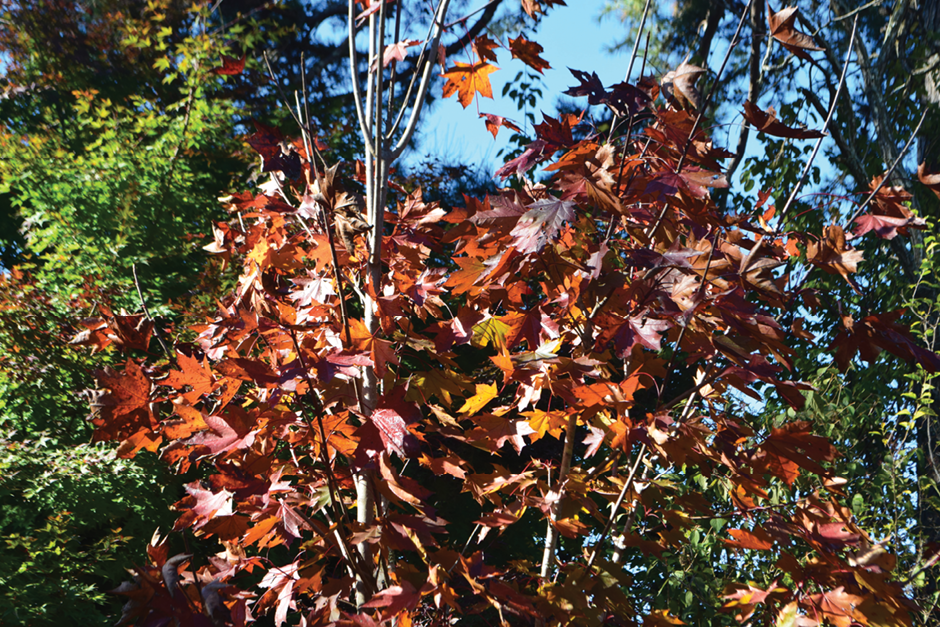
Leaves emerge reddish purple/bronze purple, metamorphosizing to lustrous dark green, (3) 5 (7)-lobed, 3 to 5 inches wide, not as high, each lobe triangular, basal lobes long extended, entire (may have serrations), tips acuminate, truncate at base (not always), the petiole 2 to 4 inches long, exuding milky sap when detached. Fall color can be spectacular (November in Athens), and my notes in the Manual mention yellow-orange, yellow-orange-red, orange-red and red, the latter specific to Main Street and Fire Dragon.
First year stems are glabrous, greenish to purplish red, turning brown when mature and marked with abundant pin-prick size lenticels. Winter buds are gray-brown, 6 to 8-scaled, the tips of buds pubescent. Bark is grayish brown, shallowly fissured, with longitudinal ridges.
The yellow/yellow-green flowers, each 1⁄3 to ½ inch diameter, five-petaled, occur in ~10 flowered, terminal, erect, corymbose, 3-inch diameter inflorescences before or with the emerging foliage in April. Flowers are usually dioecious with male and female on separate trees. This is not absolute, as the lone University of Maine tree produced a small number of sound seeds. The fruits (samaras) are 1.25 to 1.5 inches long, spreading at obtuse to right angles, maturing in October-November. In the Dirr garden, Main Street and Fire Dragon produced minimal fruit.
I receive mixed messages on absolute heat, drought and high pH tolerances. Most sources give high marks for tolerance to the above. David Creech at the Stephen F. Austin State University Arboretum in Nacogdoches, Texas, evaluated seedlings and cultivars for many years. His thoughts follow. Seedlings can be showy orange/red or blah. Main Street, Fire Dragon and Baby Dragon are top fall color performers. He reported damage in the summer of 2023 when a long drought and temperatures to 112°F burned foliage and sun-scalded branches. Based on the many places I cataloged impressive specimens, the species embodies the genetic plasticity to tolerate wide variances in climate and soils. I estimate Zone (3)4 to 8(9) for hardiness/adaptability ranges, depending on the selection. Cornell University’s Woody Plant Database listed pH range as 5 to 8.
Sapsuckers will drill holes in rings around the trunk, but this does not injure the tree. I have never observed foliage damage from insects or diseases. Several Kentucky horticulturists who Hayman surveyed mentioned Verticillium wilt on A. truncatum. They were less kind to the hybrids discussed below noting Verticillium and severe cold injury.

Propagation
Seeds require at least 30 to 60 days cold-moist stratification although Pair reported shorter periods have worked. Sheffield Seeds recommended 4 months of cold-moist stratification. A. truncatum (Sheffield seed) received 12-30-24, 24-hour soak, followed by cold moist stratification on 12-31-24, germinated in the bag 1-26-25. Seeds should always be soaked for 24-48 hours before being placed in the stratification medium. Cuttings from a 10-year-old tree rooted over 70% when treated with 1,000 or 5,000 ppm IBA. I know a Georgia commercial nursery that is rooting Main Street from cuttings. Mark Andrews of Greenleaf Nursery, Park Hill, Oklahoma, mentioned it is not easy to vegetatively propagate, with budding yielding 40% to 60% success.
Cultivars
Baby Dragon exhibits pink to purplish red on new growth and subsequent flushes. The yellow fall color is mixed with red and orange and even pink in cooler climates. Grows 12 feet high and 15 feet wide with a dense, mounding and weeping habit. Introduced by Keith Johansson of Fort Worth, Texas, who sold the company to Scott Hubble (see www.metromaples.com)
Fire Dragon exhibits vibrant fall colors, cardinal to currant red. Forms a round-headed canopy and is slower growing than Main Street in the Dirr garden. The summer foliage is waxy, sheeny dark green, the vibrant fall colors consistently produced. Selected in Fort Worth, Texas, in 1999 and still not well known. Greenleaf Nursery lists size as 35 feet high/wide and Zone 5 hardiness. Originator noted 25 to 30 feet high and wide in 12 years.
Main Street was introduced by Worthington Farms, Inc., Greenville, North Carolina. Mike Worthington brought me two trees — one was planted in the garden, the other at the UGA horticulture farm. The habit is oval-rounded, more upright than Fire Dragon, the branches upswept, making it suitable for street tree use. The selection grows 20 feet high and 16 feet wide according to the introducer’s web site. However, my 12-year-old tree is 30 feet high and 20 feet wide. Fall color is consistently orange-red and, in the best years, comparable to Fire Dragon. Zone 4 to 9.
Super Dragon features bright yellow-green foliage color in summer, a mix of golden-yellow, cranberry-red and white in fall. Grows 18 feet high and wide.
Hybrids
My co-author on “The Tree Book,” Keith Warren of J. Frank Schmidt Nursery in Boring, Oregon, bred and introduced hybrids with Acer platanoides, including Crimson Sunset, Norwegian Sunset, Pacific Sunset, Ruby Sunset and Urban Sunset. The hybrids are thoroughly discussed in “The Tree Book,” published in 2019 by Timber Press. To date, the selections have not become mainstream, at least in the southeastern states. The emerging purple tinged foliage matures lustrous dark green, developing shades of orange/red in autumn. The exception, Crimson Sunset, with purple leaves, that in the Dirr garden develops bronze-orange tints in fall. Pacific Sunset has performed better than Norwegian Sunset at Milliken Arboretum, Spartanburg, South Carolina, the former developing a respectable yellow-orange fall color. Ruby Sunset and Urban Sunset produced orange to red fall color in mid-November in the Dirr garden. Ruby Sunset flowers and foliage emerge much earlier than Urban Sunset. The habits are oval rounded, rather stiffly branched, the branches upswept. Buds and stems of the hybrids are larger/thicker than those of A. truncatum. Warren mentioned that the hybrids are not sterile.
Smaller trees that survive/thrive the vagaries of climate and soil are at a premium. Hayman and I believe A. truncatum is a leading candidate to partially fill the void.
Explore the August 2025 Issue
Check out more from this issue and find your next story to read.