Photos by Mark Dwyer

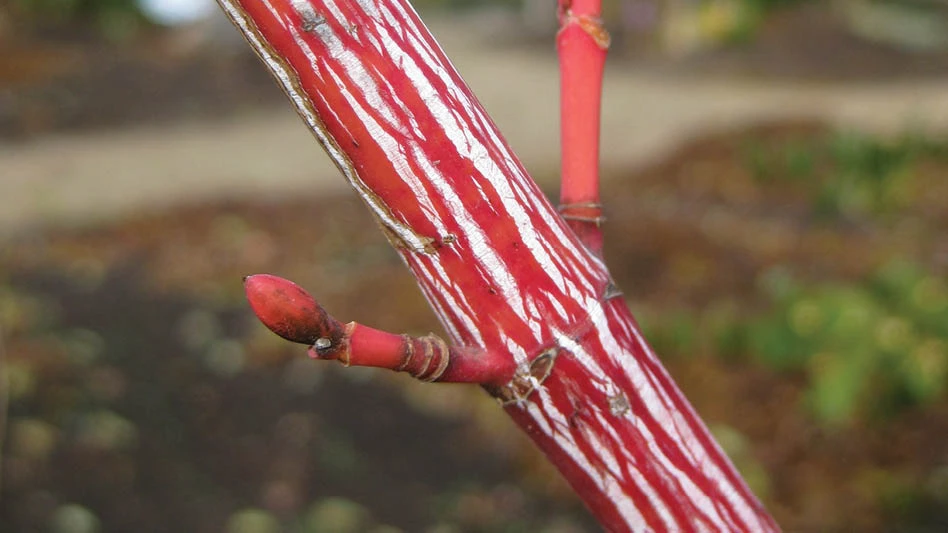
I continue to explore more diverse woody plant options for winter interest in the garden, and certainly ornamental bark and stems become part of that equation. I’ve always lived in regions with four distinctive seasons, and I appreciate the pop of bright color in the winter from the colorful stems of dogwoods (Cornus sp.) and other woodies. One of my favorite small trees for winter appeal is the ‘Erythrocladum’ snakebark maple (Acer pensylvanicum), which gets increasingly more impactful and brilliant in the winter with coral red stems and bark. While the straight species is a durable understory woody with ornamental merit, ‘Erythrocladum’ turns up the temperature in the winter garden as the air temperature drops.
Native to a wide range of the northeastern quarter of the U.S. and southeastern Canada, snakebark maple prefers moist, well-drained soil and some degree of shade, particularly in the afternoon. Hardy in USDA Zones 3-9, this species is also tolerant of humidity. The green and white streaked stems are quite showy. The variety ‘Erythrocladum’ features the typical green and white-striped stems in the warmer season but a colorful and very notable transformation occurs in the cooler months.

I planted a trio of ‘Erythrocladum’ specimens over 15 years ago in a local public garden, and the two that have survived continue as focal points during the coldest months of the year with hot red stems that are increasingly revealed after the leaves drop in autumn. In winter, the first- and second-year stems are the most vivid with a pure, coral-red contribution. Older stems and trunks become more of a brick-red to reddish-brown in time so it’s the juvenile growth that contributes the most pizzazz.
Ideally located as an understory specimen or in areas with some afternoon shade, this variety will slowly grow between 10 feet and 20 feet in height and width. The fall color of this tree ranges from a brilliant chartreuse to a buttery yellow and is consistently showy, even in shadier locations. This variety is rare in cultivation due to difficulty in propagation (grafting). Unfortunately, this species is not resistant to deer or rabbit browsing and some insect and disease problems (Verticillium wilt) should be noted. However, as a winter showpiece, the ‘Erythrocladum’ snakebark maple has few competitors for attention and when well-placed, can be a fiery beacon of warm color during those winter months.

Explore the December 2025 Issue
Check out more from this issue and find your next story to read.