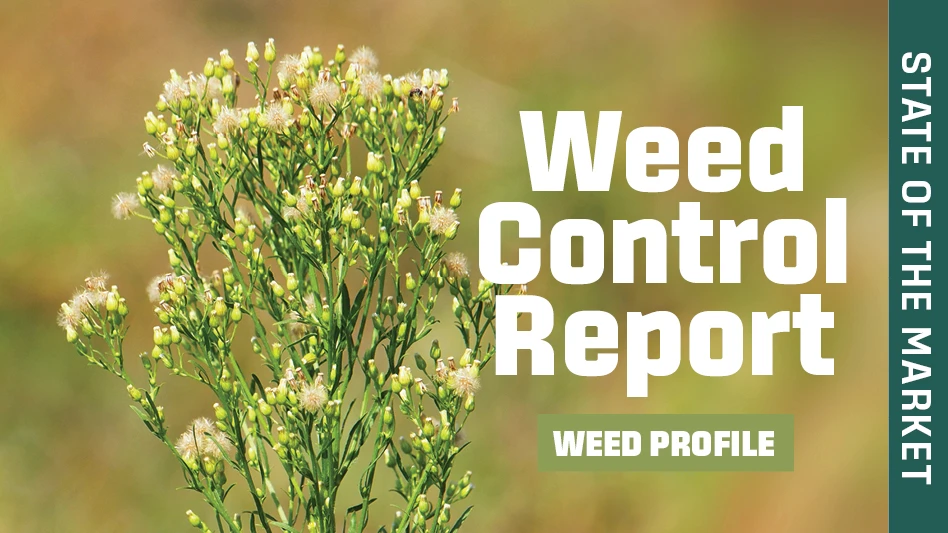
emilio100 | Adobe Stock
Marestail (Conyza canadensis, family Asteraceae), which is also known as Canadian horseweed, or just horseweed, is a plague in landscapes and nurseries. The main reason is that certain biotypes are resistant to glyphosate herbicides (e.g. Roundup). In fact, this native North America plant has become such a problem in some states that it has been added to several state’s noxious weeds list.
Marestail is problematic due to vast seed reproduction in two cycles, wind dissemination, lack of seed dormancy, and adaptability to both moist and dry soils.
Marestail has small, pea-sized, white, daisy-like flowers that are similar to dandelion puffballs. These flowers produce thousands of wind-dispersed seeds. Marestail can be misidentified as mouse-ear chickweed, shepherd’s purse, or annual fleabane.
Growing conditions
Marestail presents three management challenges. First, the weed can flourish under a wide range of growing conditions. It will endure both drought as well as water-logged soils such as in drainage ditches. Plants will produce viable seeds in poor, low nutrient soils as well as highly fertile soils. Growth appears unaffected by soil pH with plants thriving in both alkaline and acidic soils.
Life cycle
The second challenge is this annual weed’s opportunistic life-cycle with the ability to behave both as a summer and winter annual. Seeds may germinate in late-summer to early fall (winter annual cycle) or in the spring (summer annual cycle).
Once seeds germinate, the plant forms a ground-hugging rosette that can be easily mistaken for other weeds. As a winter annual, marestail remains in the rosette stage through the winter, and then it bolts in the spring. As a summer annual, the weed remains in the rosette stage for only a very short time, and then it bolts in early to mid-summer. Thus, seed production is asynchronous with seed heads appearing at different times of the year.
Once marestail bolts, it quickly forms a single, unbranched hairy stem that is densely covered in alternating oblanceolate leaves measuring 3 - 4 inches in length. Leaves near the base of the stem are longer and somewhat toothed compared to leaves near the top of the stem. As flowers are produced, old leaves on the lower stem wilt and turn brown.

Cultural control
Remove marestail seedlings when they are small, before they flower and go to seed. Hoeing, hand weeding, or tilling can be effective, especially in container nursery crops, and is the only option for removing large weeds.
Clean equipment before use or between fields with high pressure water or compressed air to prevent spreading cut vegetative pieces/propagules. Control weeds in adjacent fields/beds to prevent seed spread.
Mulch will help suppress seed germination. If seed does germinate, maintaining a 2 – 3 inch mulch layer makes hand-pulling more effective because plants will partially root in the loose mulch rather than entirely in the soil. Trying to hand-pull young plants anchored in dry or compacted soil often results in the single stem breaking off.
Chemical control
Herbicides should be applied when weeds are small and most vulnerable to control (preferably in the seedling or rosette stage, less than 4 inches tall, and prior to flowering). Since marestail can germinate in the fall and in the spring, you may need to split pre-emergent treatments. Apply fall pre-emergent treatments by early August and do spring pre-emergents by mid-to-late March.
In a container nursery production cycle, herbicide application timing is important: 1) during liner propagation, 2) site preparation before setting containers on ground, 3) at potting, 4) approximately one month after potting.
Residual herbicides can be effective if applied at the seedling/rosette stages. It can provide control through early June. Burndown herbicides can be applied when plants are 4-6 inches tall or before weeds reach the bolting period. Post-emergent herbicides should contain three to four sites (mechanisms) of action to manage glyphosate-resistant marestail.
Explore the November 2025 Issue
Check out more from this issue and find your next story to read.