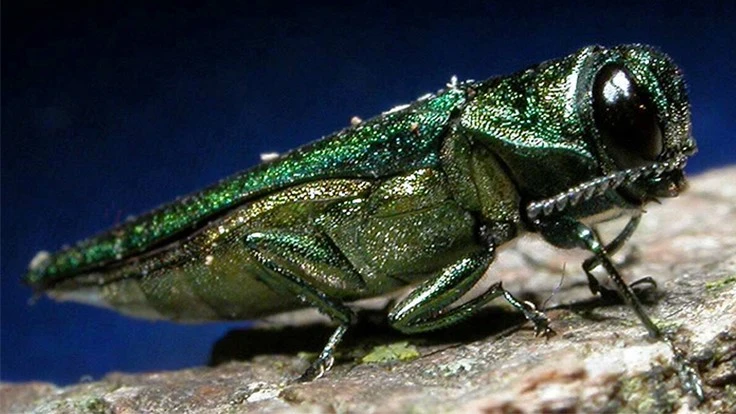
David Cappaert, Michigan State University, Bugwood.org
It is unknown whether this pest arrived in Larimer County by natural spread or via accidental human transport, such as in firewood or other raw ash material. Staff with Larimer County and the city of Loveland recently helped to obtain insect samples gathered near Berthoud, after an arborist brought an ash log containing the insects to the Loveland recycling center. A Colorado State University Extension agent delivered the insects to an EAB expert on campus, who first confirmed it as being the pest; it was then confirmed a second time this week by a national EAB expert in Brighton, Mich.
The infested ash was located on private property in unincorporated Larimer County, less than three miles southwest of Berthoud. Foresters are now in the process of conducting field inspections of ash trees on other properties in the vicinity, to determine the extent of observable EAB infestation.
EAB was first confirmed in Colorado in 2013, in the city of Boulder. Since then, the pest has been confirmed in several other municipalities in Boulder County within the quarantine, as well as in Broomfield in late August, and Westminster in September.
For more information about ash tree identification, the symptoms of EAB and treatment options, go to eabcolorado.com or csfs.colostate.edu/emerald-ash-borer.
Latest from Nursery Management
- [SNEAK PEAK] Leading Women of Horticulture: Louise Schaefer and Susan Tantsits
- The Growth Industry Episode 10: State of the Horticulture Industry
- Tennessee Green Industry Field Day scheduled for June 11
- UTIA and UT Knoxville research teams will develop automated compost monitoring system
- Ken and Deena Altman receive American Floral Endowment Ambassador Award
- [SNEAK PEEK] Leading Women of Horticulture: Becky Thomas
- [SNEAK PEEK] Leading Women of Horticulture: Angela Burke
- [SNEAK PEEK] Leading Women of Horticulture: Alexa Patti